CPR Course $55 Gold Coast: Is It Accredited? Find Out Here
You're standing in the Bunnings car park. Someone collapses twenty metres away. People are looking around. Nobody moves. You took a CPR course, but that was two years ago, and right now your mind is blank. You step forward anyway, because you're the kind of person who does.
The question isn't whether you'd try. It's whether your training was good enough to actually keep that person alive.
That's the thing nobody talks about when you're scrolling through CPR courses online, all of them claiming to be the real deal. A low price doesn't mean a bad course. But it also doesn't guarantee a good one, and the difference between solid training and a rushed tick-and-flick isn't something you can fake your way through.
So before you book a CPR course on the Gold Coast, one question is worth answering properly: is the certificate going to be accepted at your next site induction, and will you actually know what to do when someone's life depends on it?
In this article, we'll explain what ASQA accreditation actually means, what the HLTAID009 unit requires, why Gold Coast CPR pricing varies between providers, and exactly how to verify any provider before you hand over a dollar.
Is a CPR Course on the Gold Coast Actually Accredited?
A CPR course on the Gold Coast can be fully ASQA-accredited, but only if it's delivered by a Registered Training Organisation listed on the national register at training.gov.au. Accreditation isn't determined by what a provider charges. It's determined by the RTO's registration status and whether the course delivers the nationally recognized unit of competency HLTAID009 (Provide Cardiopulmonary Resuscitation).
Before booking any CPR course, confirm:
The provider's RTO number is displayed on their website
HLTAID009 appears on their scope of registration at training.gov.au
The certificate issued is a Statement of Attainment under the ASQA framework
The course includes a face-to-face practical assessment component
What Does "ASQA-Accredited" Actually Mean for a CPR Course?
What ASQA Is and Why It Matters
ASQA stands for the Australian Skills Quality Authority, the national regulator for vocational education and training in Australia, covering every CPR course that issues a nationally recognized qualification.
If a training provider isn't registered with ASQA, they can't legally issue a Statement of Attainment, the document your site induction officer or employer will ask to see. Without it, you've got a piece of paper that looks official and means nothing.
The register is public and takes about thirty seconds to check at training.gov.au, where you'll see whether a provider is registered and what they're authorized to deliver.
What an RTO Number Means, and How to Check One
Every registered training organisation in Australia has a unique RTO number, issued by ASQA and tied directly to their registration status. A legitimate CPR provider will display this number prominently on their website, usually in the footer, on the course page, or on the certificate itself.
Why Non-Accredited CPR Certificates Get Rejected at Site Inductions
Site induction officers in Queensland check RTO numbers, and they've seen every variation of the fake-looking cert and the expired provider. If your certificate doesn't come from a current, registered RTO with HLTAID009 on their scope, you're getting turned away at the gate, and on the morning of a new project start, that means you're off the tools until you fix it.
Safe Work Australia's guidelines on first aid in the workplace make clear that training must be delivered by a registered provider. RTO registration is what counts, not what a provider charges.
Now you know what accreditation means. Here's exactly what a legitimate HLTAID009 course should cover when you walk through the door.
What HLTAID009 Covers, and What You'll Actually Learn
The HLTAID009 Unit of Competency Explained in Plain English
HLTAID009, Provide Cardiopulmonary Resuscitation, is the nationally recognized CPR-only unit under the HLT Health Training Package. It's the qualification your employer asks for, the one on site induction checklists, and the one that needs renewing every twelve months to stay current.
In plain terms, it covers three things: recognizing a cardiac arrest, performing CPR correctly, and using an AED if one is available. The technical content is built on Australian Resuscitation Council (ARC) guidelines, published through ANZCOR at anzcor.org, which set the national standard for compression depth, rate, rescue breath ratio, and AED protocols. A quality RTO will always deliver training aligned to the current ARC guideline version.
Face-to-Face vs Online CPR Training: What the Rules Actually Say
This is where a lot of people get caught out. You'll find fully online CPR courses advertised across the Gold Coast, and some look legitimate. None meet the ASQA requirement for workplace compliance.
ASQA requires a face-to-face practical assessment component for HLTAID009: physically demonstrating CPR on a mannequin, correct hand placement, adequate compression depth, proper rate, in front of a qualified assessor. You cannot do that through a screen. A certificate issued without a practical component isn't valid for site inductions, NDIS compliance checks, or childcare regulatory requirements.
If the course you're looking at is entirely online, it's not HLTAID009.
What Hands-On Assessment Looks Like in a Quality Course
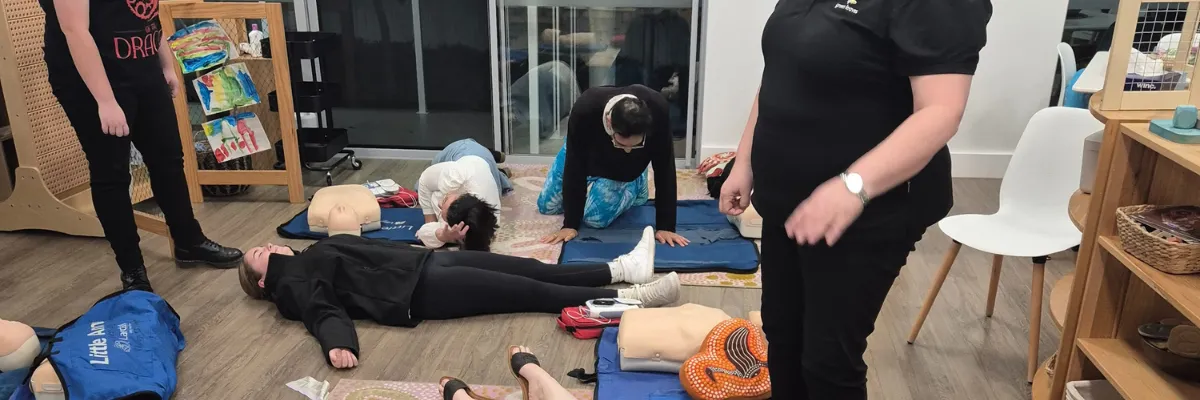
A quality HLTAID009 course on the Gold Coast should include individual mannequin time for every participant, building the real muscle memory for compression depth and rate, not just watching a trainer demonstrate it once. A well-run course will also include scenario-based practice, walking through a realistic cardiac arrest situation from recognition to AED use, and dedicated time with an actual defibrillator so you know what the prompts sound like.
That's what the course should teach. Here's why providers charge such different amounts for what looks, on paper, like the same qualification.
Why CPR Course Pricing Varies on the Gold Coast
What Drives the Price Difference Between CPR Providers
CPR courses on the Gold Coast vary in price for what appears, on the surface, to be the same qualification. The answer comes down to overhead, not quality: venue costs vary depending on where and how a provider runs sessions, trainer-to-participant ratios affect cost since smaller groups mean more trainer hours per certificate issued, and providers with heavy marketing spend pass some of that cost on through their pricing. None of those factors determine whether the training is good.
What a Lower-Cost Course Should Still Get You
A well-run RTO operating efficiently, keeping venue and administration costs lean, can legitimately deliver a fully ASQA-accredited HLTAID009 course at a competitive price. The compliance requirements don't change based on what you paid, and the face-to-face practical assessment is mandatory regardless of price point.
What a properly run course should still get you, regardless of cost:
A qualified, experienced trainer delivering ARC-aligned content
Individual hands-on mannequin time
AED familiarization
A face-to-face practical assessment
A nationally recognized Statement of Attainment issued the same day
An ASQA-registered RTO number on your certificate
Red flags at any price
No RTO number displayed on the website or certificate
No face-to-face practical component, fully online delivery for a CPR qualification
Certificate issued without a physical assessment being completed
A premium-priced course from an unregistered provider is worthless. A competitively priced course from a current, compliant RTO is fully valid. The RTO number and the practical component are what matter, not the price.
Group Bookings and Workplace Rates
If you're thinking about getting your crew trained, most Gold Coast RTOs, including [RTO_NAME], offer workplace group rates for teams booking together, worth a direct conversation before assuming a single advertised rate is the only option.
A site supervisor from the Gold Coast booked a CPR course after his workplace updated its induction requirements. He arrived expecting a box-tick. He left having done real hands-on compression practice, run through cardiac arrest scenarios, and familiarized himself with a defibrillator for the first time. His Statement of Attainment was in his inbox before he reached his car, and at his next site induction, the cert was accepted without question.
Price checked. Now here's the process to verify any Gold Coast CPR provider before you hand over a dollar.
How to Verify Any CPR Course Before You Book
You don't need to be an expert in vocational training regulation to work out whether a CPR provider is legitimate.
Step 1: Find the RTO Number and Check training.gov.au
Every legitimate CPR provider will have their RTO number on their website, in the footer, on the course listing page, or in the terms and conditions. If you can't find it after thirty seconds of looking, that tells you something.
Search the number on training.gov.au. You'll see the organization's name, their registration status, and the states they're approved to deliver in. If they're not on that register, or their registration has lapsed, walk away.
Step 2: Confirm HLTAID009 Is on Their Scope of Registration
Being a registered RTO doesn't automatically mean a provider is approved to deliver every qualification. Each RTO has a scope of registration, a list of units they're authorized to assess and certify. Check their scope for HLTAID009 on training.gov.au. If it doesn't appear, the certificate they issue for that unit isn't valid, regardless of what the course page says.
Step 3: Check That a Practical Assessment Is Included
Look for specific language on the course page, "hands-on mannequin practice", "face-to-face practical assessment", "individual assessment with a qualified trainer". Vague phrases like "interactive learning" without any mention of physical assessment are worth questioning directly. If the course can be completed entirely online, it doesn't meet the ASQA requirement for HLTAID009. Call the provider and ask: "Does this course include a face-to-face practical assessment?" A legitimate provider will answer without hesitation.
Step 4: Read the Reviews, What to Look For Specifically
Star ratings alone don't tell you much. Look for specific comments about the quality of the training, not just "great course, highly recommended." Reviews worth paying attention to sound like this:
"The trainer had real experience, you could tell straight away"
"Actually felt prepared afterwards, not just like I'd ticked a box"
"Certificate came through before I'd even got home"
Reviews from tradespeople, construction workers, and parents carry particular weight if you're in that peer group, and certificate turnaround is worth checking too: same-day or next-business-day digital issue is the benchmark for a quality provider.
Nationally recognized means accepted at every Queensland worksite, every NDIS induction, every childcare compliance check.

What Happens During the Course
There's no complex preparation required for a HLTAID009 course on the Gold Coast. Wear comfortable clothes you can move in, since you'll be kneeling on the floor performing compressions, and bring ID and your booking confirmation.
Here's what the course flow looks like from arrival to certificate:
Theory. The session opens with the core knowledge component: recognizing cardiac arrest, the DRSABCD action plan, when and how to call 000, and the ARC guidelines underpinning compression technique and rescue breaths. It's a practical briefing that sets up everything you're about to do with your hands.
Practical demonstration. Your trainer demonstrates correct CPR technique on a mannequin before you do it yourself, covering compression depth, hand placement, rate, and rescue breath technique.
Individual assessment. Every participant performs CPR individually in front of the assessor. This is the face-to-face practical component that ASQA requires and that makes the qualification valid, with the trainer giving real-time feedback on your technique.
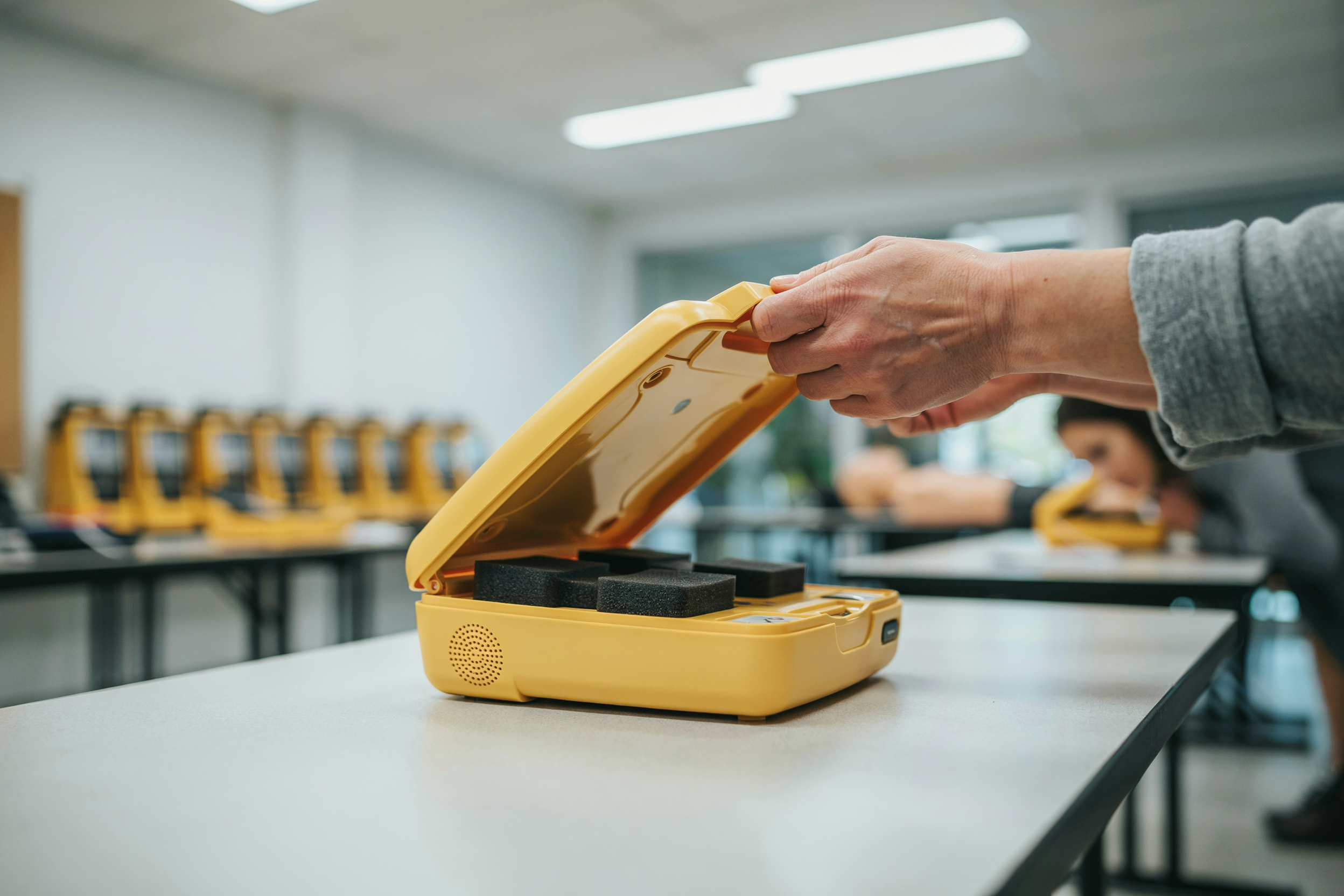
AED familiarization. You'll handle an actual defibrillator, hear the audio prompts, and work through what to do when one is available at a cardiac arrest. A lot of people have never touched an AED before their CPR course, and by the end of this section, the device won't feel foreign.
Certificate issue. Your digital Statement of Attainment is issued the same day, ASQA-accredited, nationally recognized, and accepted at every Queensland site induction without question.
A CPR refresher on the Gold Coast through RTO covers the same ground whether it's your first course or your annual renewal. The face-to-face assessment doesn't get easier just because you've done it before, but most people find their technique sharper the second time around.
Ready to Book Your Gold Coast CPR Course?
A CPR course on the Gold Coast doesn't need to be a compromise. When the provider is a registered RTO with HLTAID009 on their scope, the certificate you walk away with is identical in legal standing to one delivered by any other compliant provider. A nationally recognized Statement of Attainment is a nationally recognized Statement of Attainment, full stop.
What separates a good course from a bad one comes down to whether a qualified trainer put you through a genuine face-to-face practical assessment, whether you got enough time on the mannequin to build real muscle memory, and whether you left the room feeling like you could actually do it, not just hoping you could.
The verification process is straightforward: RTO number on training.gov.au, HLTAID009 on their scope of registration, face-to-face practical assessment confirmed, and reviews that mention trainer quality rather than just a star rating.
The moment that makes this worth doing isn't the site induction. It's the one you can't predict, a workmate on a hot afternoon, a stranger in a car park, someone at a family barbecue. When that moment comes, the only thing that matters is whether your training was real enough to carry you through it.