CPR Choking Response Course Australia: What's Covered?
If someone at your worksite started choking right now, would you know the difference between a partial blockage and a full obstruction? Most people don't. And that split-second distinction is exactly what determines whether your response helps or makes things worse.
Choking emergencies don't announce themselves. They happen at smoko, at the family dinner table, or on a job site with eight blokes watching. When they do, the person nearest to the casualty becomes the first responder, whether they're ready or not.
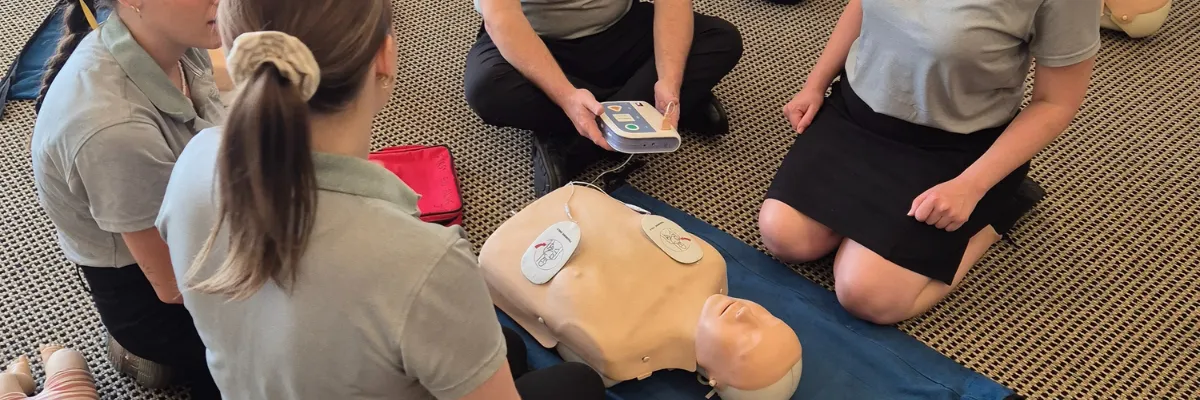
A CPR choking response course in Australia teaches you exactly what to do in those first vital minutes: how to assess the severity of an airway obstruction, when to act and how, and how choking response connects to CPR when a casualty becomes unresponsive.
What Is Covered in a CPR Choking Response Course?
A CPR choking response course in Australia covers the knowledge and hands-on skills needed to recognize and respond to airway obstruction emergencies. Aligned to Australian Resuscitation Council (ARC) guidelines, a quality course will cover:
Recognizing choking identifying partial vs complete airway obstruction in adults, children, and infants
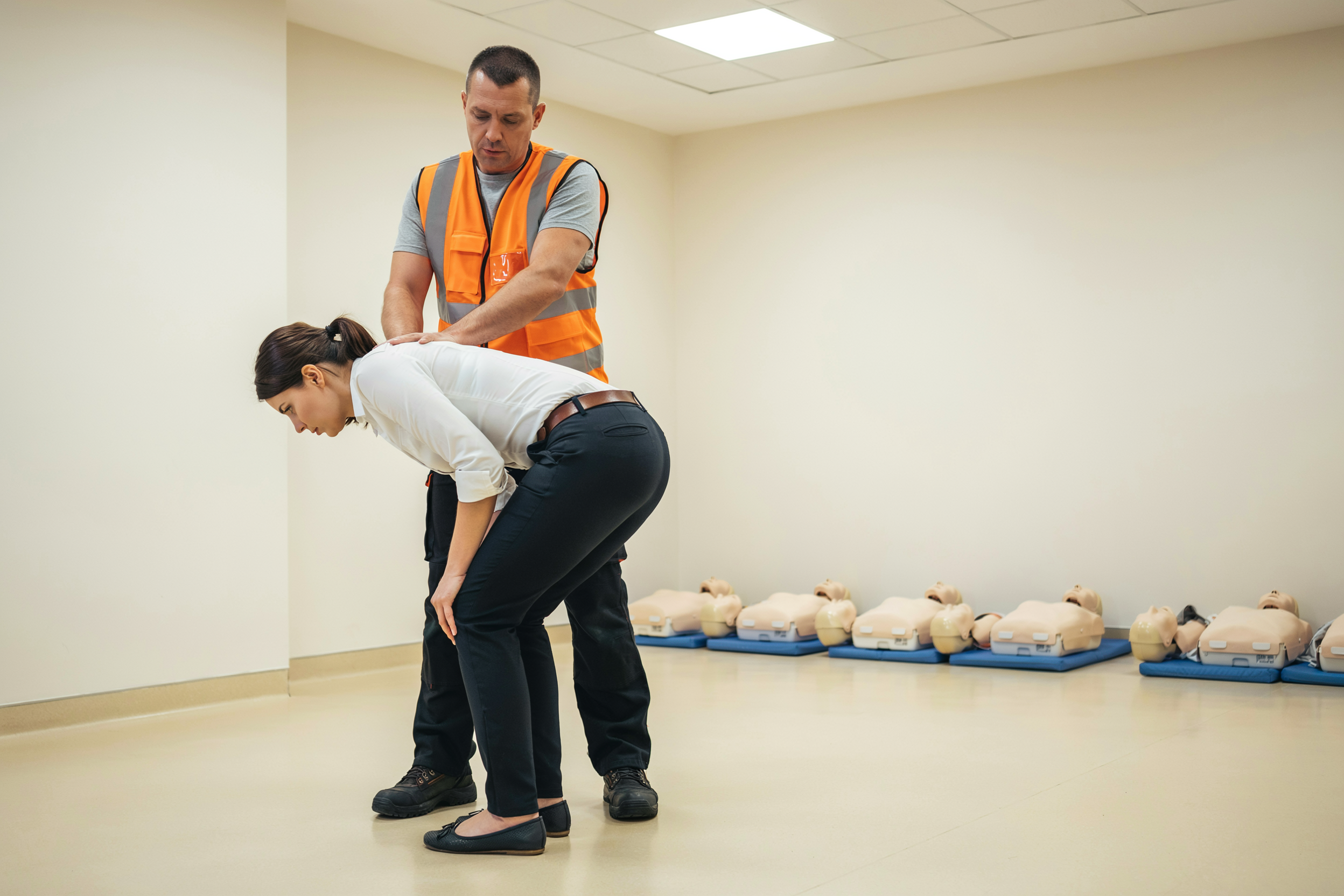
Conscious choking response back blows and abdominal thrusts (Heimlich manoeuvre) performed correctly
Infant choking response modified technique for babies under 12 months
Unconscious casualty management moving to CPR when a choking casualty becomes unresponsive
AED awareness when a defibrillator may be required following cardiac arrest from prolonged obstruction
DRSABCD action plan the ARC's primary emergency response framework
Why Choking Response Is Part of CPR Training in Australia
Most people associate CPR with cardiac arrest, chest compressions, rescue breaths, a defibrillator. But the Australian Resuscitation Council (ARC) includes choking response within its core resuscitation guidelines for a straightforward reason: an untreated airway obstruction can lead directly to cardiac arrest.
When a casualty's airway is completely blocked and oxygen stops reaching the brain, unconsciousness follows within minutes. If the obstruction isn't cleared, the heart stops. At that point, choking has become a cardiac arrest and CPR becomes the next required response.
This is why a quality CPR choking response course in Australia doesn't treat these two skills as separate topics. They sit on the same clinical continuum. You learn choking response and what happens if it fails.
The ARC and ANZCOR Framework
Australia's resuscitation training standards are set by the ARC and align with the Australian and New Zealand Committee on Resuscitation (ANZCOR) guidelines. These guidelines are updated periodically based on international evidence and define the techniques, sequence, and decision points that all ASQA-registered training organizations must follow.
When you book a course with an ASQA-accredited RTO, you're getting training built on these national standards, not a provider's own interpretation of what to do.
Why This Matters on a Worksite
On a construction or industrial site, choking emergencies are more common than most supervisors expect. Dust, debris, and eating quickly during short breaks all elevate risk. Under Queensland's Work Health and Safety Act 2011, employers have a duty to make sure workers can respond to foreseeable medical emergencies. For a site supervisor, that responsibility doesn't sit with management in an office somewhere. It sits with you.
What a CPR Choking Response Course Covers: Section by Section
A properly structured CPR choking response course covers specific, sequenced content that builds genuine muscle memory, not just theoretical recall. Here's what should be in it.
Recognizing an Airway Obstruction
Before you can respond, you need to correctly identify what you're dealing with. A course aligned to ARC guidelines will teach you to distinguish:
Mild (partial) obstruction the casualty can cough, speak, or breathe; encourage forceful coughing and monitor closely
Severe (complete) obstruction the casualty cannot cough effectively, cannot speak, or is turning blue; immediate physical intervention is required
Misreading this distinction is one of the most common first responder errors. Acting too aggressively on a mild obstruction can worsen the situation. Waiting too long on a severe one can be fatal.
Conscious Adult Choking Response
For a conscious adult with a severe airway obstruction, ARC guidelines direct a specific sequence:
Five back blows firm strikes between the shoulder blades using the heel of the hand
Five abdominal thrusts inward and upward compressions just above the navel (Heimlich manoeuvre)
Alternating cycles continue until the object is dislodged or the casualty loses consciousness
A quality course doesn't just describe this sequence. It has you practice it until the movement is automatic.
Infant and Child Choking Response
The technique changes significantly for infants under 12 months. Abdominal thrusts are not used on babies as the risk of internal injury is too high. Instead, ARC guidelines specify:
Five back blows delivered face-down across the rescuer's forearm
Five chest thrusts two fingers on the center of the chest, similar to infant CPR compressions
For children over 12 months, the adult technique applies with modified force. A course worth booking covers all three age groups, not just the adult scenario most providers default to.
Transitioning to CPR
If physical interventions fail and the casualty loses consciousness, the response moves immediately to CPR. Your course should cover:
How to position an unconscious choking casualty for CPR
Whether to look in the mouth for a visible obstruction before commencing compressions
The correct compression-to-breath ratio under current ARC guidelines
When and how to call 000 during a solo response
The DRSABCD Action Plan
Every ARC-aligned course anchors choking response within the broader DRSABCD emergency action plan:
Understanding where choking response sits within this framework, specifically at the Airway step, is what separates trained responders from people who know a few techniques but don't know when to use them.
Adults, Children, and Infants: Why the Technique Changes
The right technique depends entirely on who is in front of you. The same intervention that clears an airway in an adult can cause serious internal injury in a baby. This is why ARC guidelines specify distinct responses for three separate age groups, and why a course that only teaches adult technique is leaving you underprepared.
Adults and Children Over 12 Months
The response sequence is the same: back blows followed by abdominal thrusts, alternating until the obstruction clears or the casualty loses consciousness. Key variables that change with age and size:
Force scaled to the casualty's body size; a child requires significantly less force than an adult male
Positioning leaning a smaller child forward may require a different stance from the rescuer
Monitoring children can deteriorate faster than adults; the move to CPR may come sooner than you expect
Infants Under 12 Months
Abdominal thrusts are never used on a baby under 12 months. The ARC-specified sequence is:
Position the infant face-down hold the baby along your forearm, head lower than the chest
Deliver five back blows firm blows between the shoulder blades using the heel of your hand
Turn the infant face-up carefully rotate along your other forearm, still supporting the head below chest level
Deliver five chest thrusts two fingers on the center of the chest just below the nipple line
Check the mouth only remove a visible object; blind finger sweeps are not recommended under ARC guidelines
Repeat until the object is dislodged, the infant breathes normally, or CPR is required.
When Choking Response Becomes CPR
Choking and cardiac arrest are often the same emergency at different stages. Here's how the progression works:
Oxygen supply drops with the airway blocked, no fresh oxygen reaches the lungs
Blood oxygen levels fall within two to three minutes, oxygen saturation begins declining sharply
Unconsciousness occurs the brain shuts down non-essential functions, then consciousness
Cardiac arrest follows a heart deprived of oxygenated blood will stop within minutes
This can happen faster than an ambulance response time. By the time paramedics arrive, the window for a good outcome without bystander intervention has already closed.
When to Stop Choking Response and Start CPR
If a choking casualty loses consciousness at any point:
Lower them carefully to the ground, supporting the head
Call 000 immediately or direct a bystander to call while you continue
Look in the mouth for a visible obstruction; remove it only if clearly visible
Begin CPR, thirty chest compressions followed by two rescue breaths, or compression-only CPR if needed
Key principle: Do not delay CPR to keep searching for the obstruction. Chest compressions alone may generate enough pressure to dislodge the object, and in the meantime they're maintaining circulation to the brain.
AED Awareness in a Choking-Related Cardiac Arrest
A CPR choking response course should cover basic AED awareness, enough for you to recognize when one is appropriate, power it on, and follow the audio prompts. The device will only deliver a shock if one is indicated. Knowing where yours is and how to turn it on is the bare minimum.
Who Needs a Choking Response Course in Australia?
Anyone who is regularly responsible for other people's safety. But some groups carry a higher statistical risk of encountering a choking emergency, and for them, this training isn't optional.
Construction and trade workers. Under Queensland's Work Health and Safety Act 2011, a PCBU has a duty to provide adequate first aid equipment and make sure workers have access to trained first aiders. For site supervisors, that duty is personal. If something happens on your site and nobody knew what to do, the question of responsibility gets answered quickly, and it points at the person running the job.
Parents and caregivers of young children. Choking is one of the leading causes of accidental death in children under five in Australia. Infant and child choking response isn't an abstract compliance requirement. It's the difference between being able to act and standing helpless while waiting for an ambulance.
Aged care and disability support workers. Dysphagia is extremely common among elderly people and many NDIS participants. Workers who regularly assist with meals are in close proximity to a high-risk population, and choking response training is increasingly a compliance expectation under aged care quality standards.
Hospitality and food service workers. A diner choking at a table needs an immediate response, not someone searching their phone. The thirty seconds it takes to find an answer is thirty seconds the casualty doesn't have.
Anyone who wants to be genuinely prepared. Choking can happen at a family dinner, at a community event, in a shopping center food court. The person nearest to the casualty becomes the first responder by default. The question isn't whether you'll ever be in that position. It's whether you'll be ready when you are.
What to Look for in an ASQA-Accredited Course
The certificate at the end looks the same whether you spent three hours on mannequins with an experienced trainer or sat through a forty-minute slide deck with twenty other people. The difference shows up when something actually happens.
ASQA registration. Verify the provider is a registered training organisation (RTO) with ASQA. The RTO number should be displayed clearly on their website. If you can't find it, that's a red flag. Search the number on training.gov.au to confirm current registration in 30 seconds.
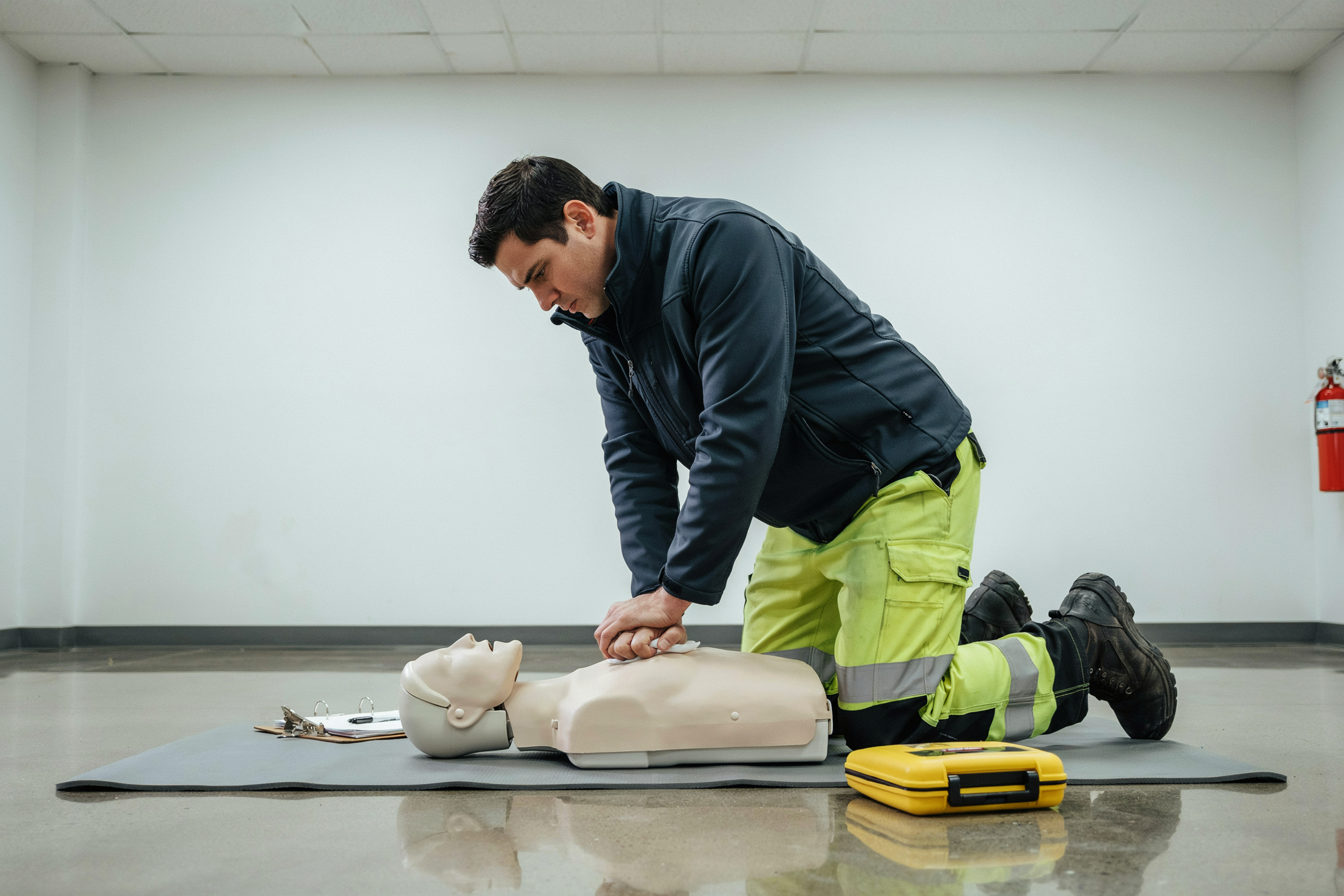
Hands-on practice time. This is where tick-and-flick providers cut corners. Look for specific language about individual mannequin access, scenario-based practice, and whether infant and child mannequins are included. Vague descriptions like "practical training included" tell you nothing.
Trainer experience. Look for trainer backgrounds listed on the website with specific credentials, Google reviews that mention the trainer by name, and any mention of real-world experience. Someone who has seen a real resuscitation situation delivers training differently to someone who hasn't.
Certificate turnaround. A provider worth booking commits to a same-day or next-business-day digital certificate, emailed as a PDF, with the unit of competency and RTO registration number clearly stated.
Ready to Stop Hoping and Start Knowing?
Choking emergencies doesn't give you a warning. They happen at random, to people nearby, and the only thing that determines whether the person in front of you survives the next few minutes is whether you've done the work beforehand.
The gap between knowing roughly what to do and actually being able to do it under pressure is wider than most people expect. Reading about back blows and abdominal thrusts is not the same as having done them on a mannequin until your hands move without thinking. That muscle memory is the whole point of proper hands-on training, and it's exactly what a tick-and-flick course doesn't give you.
Genuine competency in CPR and choking response doesn't require weeks of training. A properly structured course, delivered by an experienced trainer with adequate mannequin time, gets you there in a single session. What you walk away with is the ability to be useful in the most important moment of someone else's life.
Book the course. Do the practical work. Leave knowing that if it ever comes down to you, at a worksite, at a family dinner, in a car park, you won't freeze. That's the whole point.