
Is Your CPR Accreditation Valid? A 2026 QLD Parent Guide
The pool gate's got a CPR sign on it, the kids are in the water most arvos, and the certificate in your drawer says 2015. Plenty of Gold Coast parents are sitting in exactly that spot. Holding a CPR accreditation they earned years ago for work, and haven't really looked at since. You walk past that sign every single day. You know the "30 and 2" bit. The rest though? Bit of a blur.
So here's the short answer, straight up. A nationally recognized CPR certificate (that's HLTAID009, the current CPR unit) doesn't carry a legal expiry date. But Queensland's first aid Code of Practice and Australian Resuscitation Council guidance both recommend you refresh your CPR every 12 months. And most employers, dental, health, education, fitness, they run on the same rule.
Honestly that's the bit that catches people out. The paper doesn't go off like milk in the fridge. Your hands are what lose it.
This guide walks you through it in plain language. How to check your certificate is genuine and nationally recognized. How to tell if it's still current here in Queensland. Why infant and child CPR is worth a refresher before pool season. And how to renew close to home on the Gold Coast.
How do I check if my CPR accreditation is nationally recognized?
You can confirm your CPR accreditation is nationally recognized in five quick checks:
Find the RTO number. Every nationally recognized CPR certificate is issued by a Registered Training Organisation and shows its RTO code.
Search that number on training.gov.au. Check the RTO is current and the CPR unit is on its scope of registration.
Check the unit code. Current CPR training is HLTAID009 Provide Cardiopulmonary Resuscitation. Older certificates might show HLTAID001.
Look for "Statement of Attainment" and the Nationally Recognized Training logo.
Check your USI transcript at usi.gov.au, which lists most nationally recognized training done since 2015.
If any of these are missing, your course may not be nationally recognized.
Can't find the certificate at all? Happens more than you'd think, especially after a house move or two. The USI transcript is your best mate here, it pulls the record up even when the paper's long gone.
Genuine is only half the question though. The other half is whether it's still current.
Does CPR Accreditation Expire in Queensland?
Your certificate has no legal expiry date
When you finish a nationally recognized CPR course, what you get is a Statement of Attainment for HLTAID009. There's no expiry date printed on it by law. It doesn't self-destruct after 12 months, and nobody's going to knock on your door and confiscate it.
So when people ask if their CPR accreditation is "valid", what they really mean is current. Recent enough to meet the guidelines. Recent enough for your employer. Or recent enough for the surf club, sports team or school canteen you volunteer with. That's the version of "valid" that actually matters day to day.
There's a bit more on this in our piece on how long CPR certification lasts.
The 12-month CPR refresher guideline
Two Australian sources set the rhythm here:
Queensland's First Aid in the Workplace Code of Practice recommends annual CPR refresher training.
The Australian Resuscitation Council recommends regular refreshers, usually stated as once a year.
Notice the word there. Recommended. For everyday parents and the general public, it's not a law, it's best practice. But it's best practice for a good reason, and we'll get to that further down.
Why CPR and first aid run on different clocks
This one trips up a lot of people, and fair enough, it's a bit odd. CPR and first aid don't run on the same timer.
CPR (HLTAID009): refresh every 12 months
First aid (HLTAID011): renew every three years
Here's the trick though. HLTAID011 First Aid actually includes HLTAID009 inside it. So if you do a current first aid course, your CPR gets refreshed at the same time. They're not one-or-the-other options. Think of CPR as the engine and first aid as the whole car built around it.
What about the CPR sign on your pool gate?
If you've got a regulated pool in Queensland, you need to display a compliant CPR sign. QBCC sets out what that sign needs to look like.
What a lot of pool owners don't realize is the flip side. You're not legally required to hold CPR accreditation yourself just because you own a pool. There has been a Queensland parliamentary petition asking for mandatory CPR accreditation and annual training for pool households, so it's clearly something people are talking about. But right now, the sign is the rule.
And look, the sign is genuinely useful. It's just that reading steps off a gate in a panic is a very different thing to your hands already knowing them.
For more on fences, supervision and the rest of the pool setup, have a read of our backyard pool safety guide.
If you need CPR for work though, your employer's rules matter more than the date on the certificate.

Is Your Old CPR Certificate Still Valid for Work?
HLTAID001 and HLTAID009: same skill, newer code
If you did your CPR certificate back around 2015, there's a good chance it says HLTAID001 on it. That code's since been replaced by HLTAID009. Same core skill, newer unit, updated to match current guidelines.
Your old certificate is still genuine. It was real training from a real RTO and nobody can take that away. But here's the catch. Most employers won't accept CPR training that's older than 12 months, regardless of which code is printed on it. So genuine, yes. Good enough for work, probably not.
What dental, health, education and fitness workplaces usually ask for
The typical line you'll see in a job ad or a staff handbook is something like "current CPR within the last 12 months". That's pretty standard across dental practices, health settings, schools, childcare and gyms.
Every workplace sets its own rules though, and some are stricter than others. The easiest thing to do is just ask. A quick message to your practice manager or HR team will tell you exactly what they need, and save you guessing.
Is my CPR current? Three quick questions: when you last did CPR, what code is on your certificate, and whether you need it for work. Your answer tells you if you're current, if it's time for a refresher, or if it's worth checking together.
Coming back from parental leave
This is the one that sneaks up on people. You've been home with a newborn, time's gone weird, and suddenly your return date is right around the corner and HR's asking for your CPR.
A couple of tips from watching this happen a lot:
Book well before you go back. That gives the certificate time to land in your inbox before your first shift, not after.
Ask your employer if they'll reimburse it. Plenty of workplaces cover CPR for staff, but they won't always offer unless you ask.
Even if nobody's asking for your certificate, there's still a good reason to refresh it.
Why Parents Should Refresh CPR Every Year
CPR skills fade faster than you think
Here's the honest truth about CPR. Knowing it and being able to do it under pressure are two different things. The steps might stick around in your head. The feel of it, how deep to push, how fast to go, that's muscle memory, and muscle memory fades within months if you don't use it.
It's a bit like reverse parking a trailer. You can watch someone do it and nod along. But if you haven't done it yourself in a while, your hands go the wrong way first. A yearly refresher puts the feel back into your hands, not just the steps back into your head.
Guidelines change between courses
The Australian and New Zealand Committee on Resuscitation, ANZCOR for short, updates its guidelines as new evidence comes in. Quite a bit has shifted since 2015, including a bigger emphasis on getting an AED (defibrillator) on the person quickly and clearer guidance for everyday bystanders. If your last course was years ago, you're working off an older playbook.
Infant and child CPR is different
This is the big one for parents. CPR on a baby or a toddler isn't just adult CPR, only smaller. Your hand position changes, how deep you compress changes, and breaths are much gentler.
Choking's different too. For babies and little kids, the response is back blows and chest thrusts, done in a specific way for their size.
We're not going to walk you through the technique here, and that's on purpose. Reading about infant CPR and feeling it on an infant manikin are worlds apart. That hands-on practice, with a trainer right there telling you "a bit deeper" or "slow down a touch", is the whole point of doing the course.
For a closer look at what changes between adults, kids and babies, see our infant and child CPR guide.
Time your refresher for pool season
If you're going to do it once a year anyway, do it when it counts. Book in September or October and your skills are fresh for the November to January stretch, when the pool's getting a workout, school holidays kick in and the grandparents are visiting.
Royal Life Saving Australia's data shows water incidents climb over the warmer months, which is exactly why spring is the best time to get your hands back up to speed.
And if you've ever had to help someone and it's still sitting with you, our piece on CPR debriefing is worth a read.
A refresher is quicker than most parents expect.

How to Renew Your CPR Accreditation on the Gold Coast
Renewing your CPR accreditation is honestly one of the easier jobs on the to-do list. Our CPR course Gold Coast is built around busy parents, and if this is your very first time, our guide on how to become CPR certified on the Gold Coast covers the basics from scratch.
The blended HLTAID009 format
The course comes in two parts. First, the online theory, which you can knock over on your phone in short bursts. During a nap, on the couch after bedtime, waiting in the kindy pick-up line, whenever. Then you come in for a face-to-face practical.
One thing to be clear on. The practical assessment has to be done in person. There's no fully online way to get nationally recognized CPR, because nobody can check your compressions through a screen.
What happens on the day
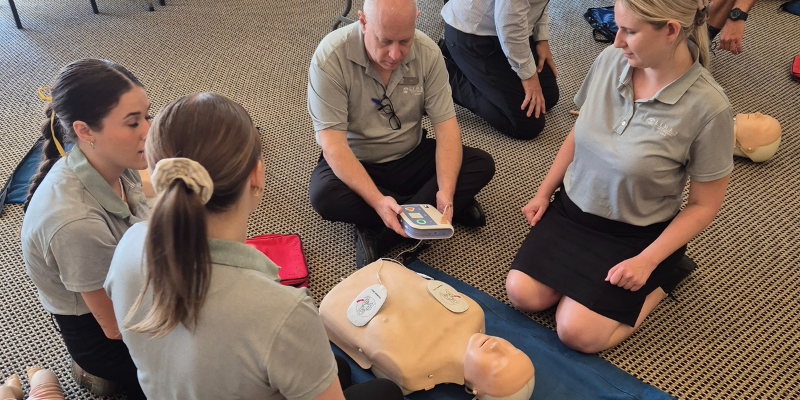
The practical is relaxed, hands-on and a lot less scary than people expect. Here's what you'll be working with:
Adult, child and infant manikins, so you practice on all three sizes
An AED trainer, so the defibrillator at the shops stops feeling like a mystery box
A calm, supportive group, plenty of whom haven't done CPR in years either
Nobody's there to catch you out. Forgetting stuff is normal, it's literally why you're there. For more detail, check out What to Expect on the Day and our guide to the HLTAID009 theory assessment.
Sessions close to home
With a baby on a feeding schedule, the nearest venue matters. Pick the session that's the easiest drive from your place, and go for a Saturday if that's when someone can mind the kids.
And if getting out of the house just isn't happening, we can come to you with a private group session. More on that below.
Bring your partner, parents or mothers' group
Here's a thought. If the grandparents mind the kids by the pool every week, they should probably know CPR too. The same goes for your partner. Booking everyone into the same session means one morning, one babysitting swap, and everyone walks out on the same page.
Booking
You can book online at acceleratefirstaid.com.au/book-type, and it's all done from your phone with no quote forms to fill in.
Nationally recognized HLTAID009. Infant and child CPR included. Book Your CPR Refresher Easy rescheduling if a little one gets sick.
Ready to Feel Confident Around the Pool This Summer?
Think of a hot afternoon this summer. The kids are splashing about, the gate's shut, and you're sitting on the edge of the pool with your feet in the water, actually relaxed, because you know that if something went wrong your hands would know what to do.
That's really what all of this comes back to. Your CPR accreditation doesn't have a legal expiry date, and an old certificate is still genuine. But the guidelines recommend a refresher every 12 months for a reason, and it's not about the bit of paper. It's about the skill still being there when you reach for it.
So start simple. Pull out your certificate, or log into your USI transcript if the paper's gone walkabout, and run it through the five checks from earlier. RTO number, training.gov.au, unit code, Statement of Attainment, USI.
If it's more than 12 months old, book your refresher. September and October are the sweet spot, but honestly, any time before the pool gets busy is a good time. And if you're heading back to work soon, get it sorted before your first shift so you're not chasing it later.
Then think about who else minds the kids. Your partner, the grandparents who do afternoons by the pool, the friend who has the kids over for playdates. Bringing them along to the same session means one morning out, and everyone around your kids is on the same page.
Nobody expects you to be a paramedic. You just want to be the calm one if it ever matters. A bit of hands-on practice each year is a pretty small price for that kind of peace of mind.