Completing WHS Documentation Correctly in 2026 | QLD Guide
It's 6:45am on a rooftop solar job. The sun's barely up, the supervisor hands you the SWMS and says "read it and sign," and the crew is already unloading panels off the trailer. Most new trades assistants sign without a second look. Pen down, gloves on, up the ladder. But completing WHS documentation correctly starts right there, with that one signature.
On Queensland sites, the paperwork is how everyone agrees on the hazards, the controls and who does what. It's the game plan the whole crew works off. A SWMS you've actually read, a hazard report filled in properly and an incident form written on the day protects you, your crew and your shot at an apprenticeship. Rushed or skipped forms leave gaps exactly when someone needs answers.
You don't need to be a strong writer to get these forms right. You need to know what each one is for, what goes in each box, and when to speak up.
This guide walks you through the WHS documents you'll see on a Queensland job site, how to fill in a SWMS, hazard report and incident report step by step, the mistakes that catch out new TAs, and how UEECD0007 covers all of this before your apprenticeship starts.
How Do You Complete WHS Documentation Correctly?
Completing WHS documentation correctly means recording hazards, controls and incidents accurately, on time and in plain language, so everyone on site works from the same information. To get it right:
Read the whole document before work starts, not just the signature line.
Check it matches the job you're actually doing and the conditions on site today.
Fill in every required field. Leave no blanks, and write "N/A" where something doesn't apply.
Record facts, not opinions: who, what, where, when and what was done.
Complete it on time. Finish SWMS and pre-start checks before work begins, and hazard or incident reports the same shift.
Only sign what you understand. Ask your supervisor to explain anything unclear first.
Hand it to the right person and follow your site's process for keeping copies.
Each of these steps looks a little different depending on the form in your hand. Here's how they apply to the three documents you'll see most on a Queensland site.
The WHS Documents You'll See on a Queensland Job Site
Walk onto any Queensland site and you'll get handed a clipboard before a tool. It feels like a lot of paper for a job about cables and panels, but every form is there for a reason.
Why the paperwork exists
Under section 28 of the Work Health and Safety Act 2011 (Qld), workers have duties too. You have to take reasonable care for your own safety, take reasonable care that what you do doesn't hurt anyone else, and follow reasonable instructions. Doing the forms properly is how you show it.
Electrical work adds another layer: the Electrical Safety Act 2002 (Qld), enforced by the Electrical Safety Office (ESO).
PCBU means "person conducting a business or undertaking". In plain words, the business you work for.
The everyday forms
Document | What it's for | When | Who fills it in |
SWMS | Hazards and controls for high-risk construction work | Before the job starts | PCBU prepares; crew reads and signs |
Pre-start / Take 5 / JSA | Today's conditions | Start of shift or task | Worker |
Hazard report | A hazard you've spotted | As soon as noticed | Worker |
Incident / near-miss report | What happened | Same shift | Worker with supervisor |
Site induction / sign-in | Proof of briefing | First day on site | Worker |
Isolation and permit records | Lockout, tags, permits | Before work on isolated equipment | Authorized workers; TAs follow instructions |
Heads up: Take 5s and JSAs aren't written into the law. They're site practice, so every company runs them a bit differently. Do them your site's way, and do them properly.
Of all these forms, the SWMS is the one you'll sign most often, so it's worth getting right first.
How to Read and Sign a SWMS Correctly
A SWMS (safe work method statement) is the plan for the risky parts of a job: the tasks, what could go wrong and how the crew stops it. It's not a formality.
When a SWMS is needed
The Work Health and Safety Regulation 2011 (Qld) lists 18 types of high-risk construction work that need a SWMS. Two of them come up all the time in electrical and solar:
Work where someone could fall more than 2 meters
Work on or near energized electrical installations or services
Rooftop solar usually ticks both. You're up high, around DC cabling that's live as soon as the sun hits the panels.
Five checks before you sign
Is this the right SWMS for this job and this site?
Do the hazards listed match the conditions today?
Do you understand every control in it?
Do you know who to tell if things change?
Has your supervisor walked the crew through it?
Any answer is no? Ask. Nobody worth working for minds a TA who wants to understand the plan.
Would you sign it? The SWMS says single-storey, but you're on a double-storey roof
No. The fall risk is different, so the controls might be too. Tell your supervisor before anyone goes up.
Would you sign it? Everything matches, but you don't know what "isolation verified" means
Not yet. Get your supervisor to explain it, then sign once you get it.
Would you sign it? The supervisor walked you through it, the job matches and you understand every control
Yes. That's exactly how it's meant to work.
When the job changes
Weather rolls in, the roof's steeper than quoted, a different inverter turns up. WorkSafe Queensland's guidance is that work not done the way the SWMS says has to stop until it can be. So you stop, tell your supervisor, and wait for the SWMS to be reviewed.
What a SWMS looks like (example only, made-up company Bright Ridge Solar): job details up top, then task steps, each with its hazards, controls and who's responsible, and the crew sign-off at the bottom.
A SWMS covers the hazards someone planned for. A hazard report covers the ones nobody saw coming.
How to Fill In a Hazard Report
A hazard is anything that could hurt someone. A frayed lead, a missing edge rail, a loose tile. And honestly, the TA who spots stuff and reports it is the one supervisors start trusting with more.
Spot it, report it, don't wait
Notice it. Keep your eyes open, especially when the site changes.
Make it safe, but only if there's no risk to you. A cone or barrier is fine. Climbing somewhere to fix it isn't.
Tell your supervisor straight away.
Write it up the same shift.
What to write
Write it the way you'd explain it to a mate on the crew.
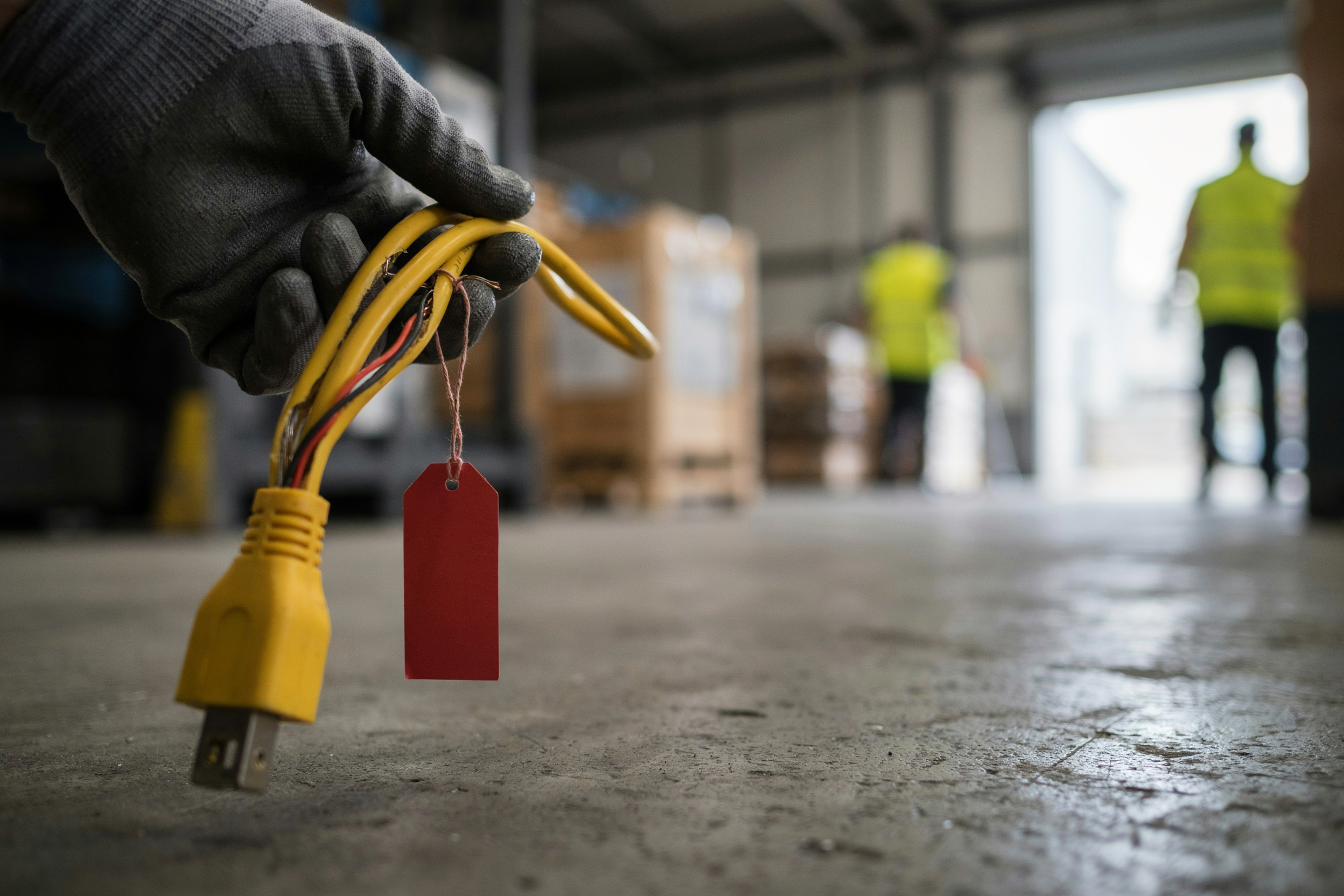
Weak vs strong: a damaged extension lead (illustrative example)
Weak: "Lead is broken. Someone should fix it."
Strong: "Tuesday morning, warehouse bay 3 near the roller door. Extension lead has the outer cover split near the plug, inner wires showing. Anyone plugging in tools could get a shock. I tagged it out of service, put it in the ute and told Dave (supervisor). Needs replacing, or testing and repair by someone qualified."
The strong one leaves nothing to guess.
The hierarchy of controls in plain words
When a hazard gets fixed, the fix should come from as high up this list as possible. It comes from the How to manage work health and safety risks Code of Practice.
Eliminate: get rid of the hazard (do the work on the ground, not the roof)
Substitute: swap for something safer (battery tools instead of leads)
Isolate: keep people away from it (isolate and lock out the circuit)
Engineering controls: change the setup (edge protection, scaffold)
Administrative controls: change how the work is done (SWMS, signage, rotating jobs in the heat)
PPE: the last line of defense (harness, gloves, eye protection)
Sometimes a hazard gets reported too late, or not at all. That's when the incident report comes in.
How to Complete an Incident or Near-Miss Report
Nobody wants to write one of these, and your heart's probably still racing when you do. But what you write is what your boss and sometimes the regulator work from.
Your job vs your boss's job
You (the worker) | The PCBU (your boss's business) |
Get help for anyone who's hurt | Notifies WorkSafe Queensland of notifiable incidents |
Report to your supervisor immediately | Notifies the ESO of serious electrical incidents and dangerous electrical events |
Leave the scene as it is, unless you're helping someone or making it safe | Looks into what went wrong and what needs to change |
Writing it up
Stick to the 5Ws: who was involved, what happened, where, when, and what happened next (first aid, who you told, what was made safe).
Only write what you saw. "The ladder slipped on the wet tiles" is what you saw. "Jacko set the ladder up wrong" is to blame, and it turns a report into an argument.
And do it the same shift, before the details go fuzzy.
Why near misses matter
Hypothetical: someone on a rooftop install starts working near a DC isolator that turns out to still be live. Nobody touches it, nobody gets hurt, everyone has a laugh and moves on.
That's when a near-miss report earns its keep. The same gap is waiting for the next crew, and writing it up gets it fixed early, while nobody's in hospital.
Most problems with these forms come down to the same handful of habits.

Common WHS Documentation Mistakes New TAs Make
Every TA makes a couple of these early, and I reckon most sparkies did too.
Signing without reading. Read the whole thing first. Your signature says you understood it.
Vague entries. "Lead's dodgy" helps nobody. Write where, what and who could get hurt.
Blank fields. An empty box looks like you forgot. Write "N/A" if it doesn't apply.
Filling it in days later. Memory fades fast. Do hazard and incident reports the same shift.
Copying yesterday's pre-start. Different weather, different roof, different risks. Do it fresh.
Not speaking up when the SWMS no longer fits. Stop and tell your supervisor. Staying quiet to look keen is the wrong kind of keen.
Guessing causes in incident reports. Write what you saw, not what you think happened.
Getting the whole crew up to speed? Supervisors and business owners can book group training for the team.
The good news is that every one of these habits can be learned before your first day as an apprentice.
How UEECD0007 Prepares You for WHS Documentation
Most TAs learn this stuff the hard way. UEECD0007 Apply Work Health and Safety Regulations, Codes and Practices in the Workplace teaches it before your apprenticeship starts.
What the unit covers
UEECD0007 covers the WHS legislation that applies to electrical work, your duty of care, hazard identification, risk control, SWMS and incident reporting. Same paperwork, with the reasons behind it so it sticks.
Will it count toward your apprenticeship?
UEECD0007 is a nationally recognized core unit in the electrotechnology qualifications. Check credit transfer with your apprenticeship RTO though, because they make the call.
How it works at Accelerate First Aid
Our UEECD0007 online course is 100% online and built to work on your phone. Do it on smoko or on the couch after the kids are down. No unpaid day off.
Your First Step Into the Electrical Trade
UEECD0007 Apply Work Health and Safety Regulations, Codes and Practices in the Workplace
100% online, works on your phone
No unpaid day off
Nationally recognized, in partnership with First Aid Alive (RTO 31106)
Your Next Three Steps
Getting through this guide already puts you ahead of most TAs who just sign and climb. Here's what to do next.
Step one, save the Pocket Card, so the five checks are in your pocket when the SWMS gets handed over.
Step two, complete UEECD0007 online. Knock it over on your phone and your boss sees you're serious before you've even signed.
Step three, ring your apprenticeship RTO about credit transfer and have your statement of attainment ready. One call can save you doing the unit twice.
Near energized equipment you'll also need low voltage rescue and CPR, with regular refreshers. Get your UEECD0007 done and start your apprenticeship on the right foot.