Combined CPR & AED Training Brisbane | 2026 Course Guide
Your CPR ticket expired last month. Your boss wants proof on his desk by Friday, or you're off the roster. And you've already sat through this content twice before, so the last thing you want is another day stuck in a classroom. Sound familiar?
Most people who land on a page like this aren't browsing out of curiosity, something specific has pushed them here, and there's usually a deadline attached to it.
This is exactly what combined CPR and AED training is built for. One practical session, covering both cardiopulmonary resuscitation and defibrillator use, nationally recognized, and scheduled around your shift instead of the other way around.
This course is one of the most commonly needed tickets across hospitality, fitness, childcare, aged care and trades. Most workplaces now expect staff to be confident with CPR and an AED, not just one or the other, so you can't really get away with doing half the job anymore. A staff member who can do compressions but freezes at the sight of an AED cabinet on the wall isn't really covered, and most employers know that now.
This guide covers exactly what's included, who actually needs it, and how to book a session that fits around your life, not the other way around.
No fluff, no wasted time. Just what you need before you book.
What Is Combined CPR and AED Training?
Combined CPR and AED training is one course that teaches you both cardiopulmonary resuscitation and how to safely use an automated external defibrillator, all in a single session. Instead of booking two separate courses, you learn to:
Recognise the signs of cardiac arrest and respond straight away
Perform effective chest compressions and rescue breaths
Safely apply and operate an AED alongside CPR
Follow the right sequence when both skills are needed together
This training follows ANZCOR guidelines and is usually delivered as part of a nationally recognised first aid unit. Combined training gets you there faster than doing CPR and AED as two separate courses, and it's widely accepted by employers, sporting clubs and licensing bodies.
It's worth pausing on why this even became a search term in the first place. A few years back, CPR training and AED training were sometimes marketed as separate add-ons, and plenty of people still assume that's the case. It isn't, not for the standard nationally recognised unit most Australians need. The two skills got folded together because that's genuinely how they're used in the field, and the training caught up to reflect that. If you've been searching around trying to work out whether you need one course or two, the short answer is one.
What's Included in Combined CPR and AED Training
Here's the bit that trips a lot of people up. They think "combined CPR and AED training" is some kind of add-on course, something extra bolted onto a normal CPR ticket. It's not. This is HLTAID009, and AED use has been baked into that unit's assessment requirements for a while now. You can check this yourself on training.gov.au: candidates are required to follow the AED's voice prompts and deliver at least one shock on a manikin as part of passing the unit. So when a provider markets "combined CPR and AED training," what you're actually booking is HLTAID009, just described in the way people are searching for it. No hidden extra course, no confusion, that's genuinely all it is.
CPR skills you'll cover:
Chest compressions, done properly and at the right depth and rate
Rescue breaths
The DRSABCD action plan, the framework Australian first aid follows for working out what's going on and what to do about it
AED skills you'll cover:
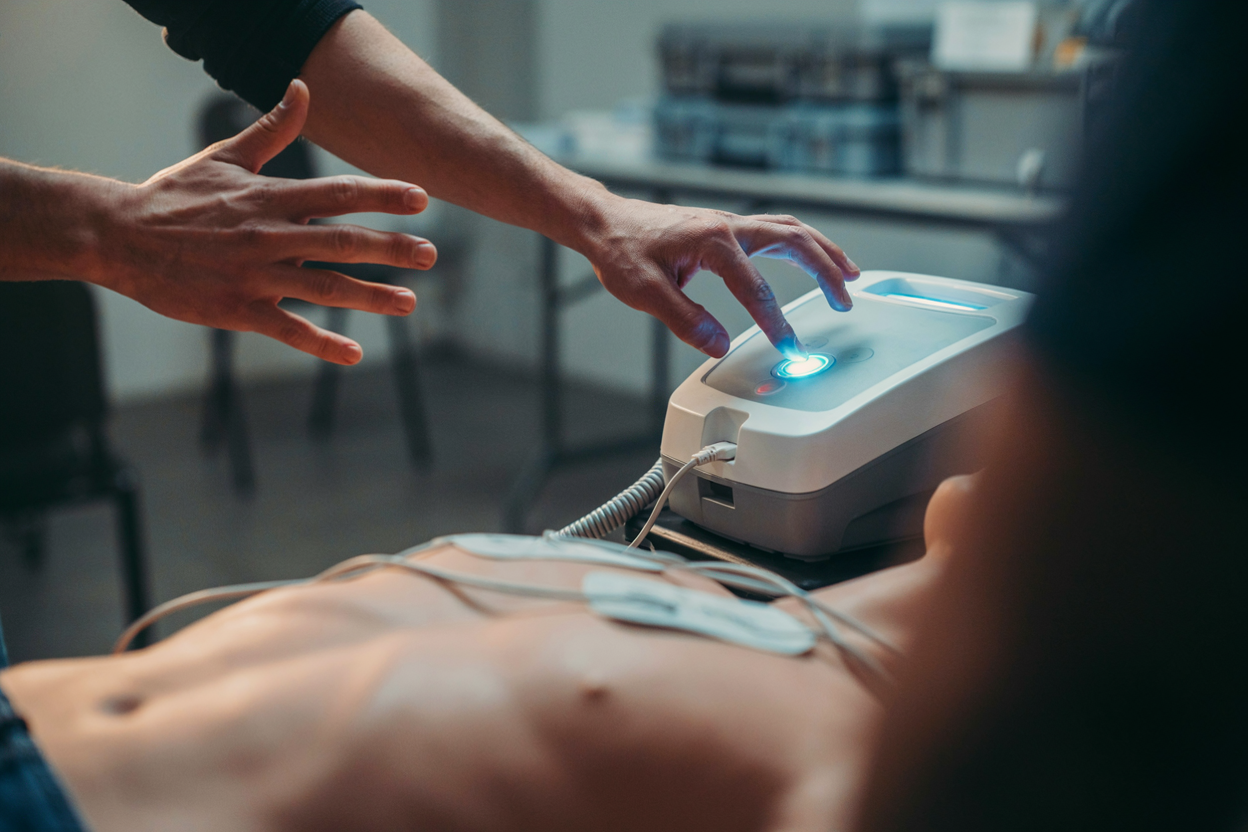
Correct pad placement on the casualty
Operating the AED using its voice prompts, because modern AEDs are built to talk you through it
Delivering a shock safely
The safety protocol around the AED and the casualty while a shock is delivered
Why are these taught together instead of as two separate things? Honestly, because that's how it plays out in real life. If someone collapses in cardiac arrest, you're not doing CPR for a while and then separately deciding whether to grab an AED later. The two work together: CPR keeps blood moving while you get the AED on and ready, and the AED does the job CPR alone can't, which is actually restarting a heart with a shockable rhythm. Teaching them apart would be a bit like teaching someone to drive without ever mentioning the brakes exist.
Knowing what's covered is one thing, knowing whether you actually need it is another.
Who Needs This Course
Workplace requirements
Hospitality, fitness, childcare and aged care are the big ones here. If you're pulling beers or coffees on a busy shift, working the floor at a gym, looking after kids at a centre, or supporting older Australians in aged care, chances are your employer already requires this ticket, or will soon. It's become close to a baseline expectation rather than a nice-to-have, mostly because these are all environments where a cardiac event can genuinely happen and staff are the first people on scene, well before an ambulance arrives.
Coaching and club accreditation
If you're coaching junior sport, running a swim squad, or volunteering at a surf club, your accrediting body has probably already told you this is non-negotiable. Sporting clubs have gotten a lot more serious about this over the last few years, and fair enough, a coach or club official is often the closest adult around when something goes wrong.
New parents and carers
This group is a bit different. They're not doing this because a boss or a club is chasing them. They're doing it because they lie awake thinking, "if something happened to my kid, would I actually know what to do?" That's a real and pretty common thought, and it's worth saying plainly: this course is exactly the answer to that question. It's not about ticking a compliance box, it's about being the person in the room who knows what to do while help is still on its way.
There's also a growing group of grandparents booking this course off their own back, without anyone chasing them at all. They're not employed, they're not part of a club, but they're doing regular childcare for grandkids and want the same confidence a parent would want. It's a good reminder that this course isn't only for people with a badge or a job title attached to the requirement.
Tradies and site-based workers
If you're on a job site, especially a larger one with a principal contractor overseeing multiple crews, having staff with current CPR and AED competency is often baked into site induction requirements before you're even allowed through the gate. It's not always the loudest requirement on the list, but it's usually one of the first things checked.
If you land here unsure whether you need the CPR-and-AED version or the full first aid course, keep reading, we cover that comparison a bit further down.
What to Expect on the Day
You turn up, and it moves at a genuine pace, which is the whole point. There's a short theory component covering the DRSABCD framework and core CPR/AED knowledge, kept brief and practical rather than lecture-style. Nobody's sitting through slide after slide of content they could have read themselves. The talking is kept to what actually matters for the practical work that follows.
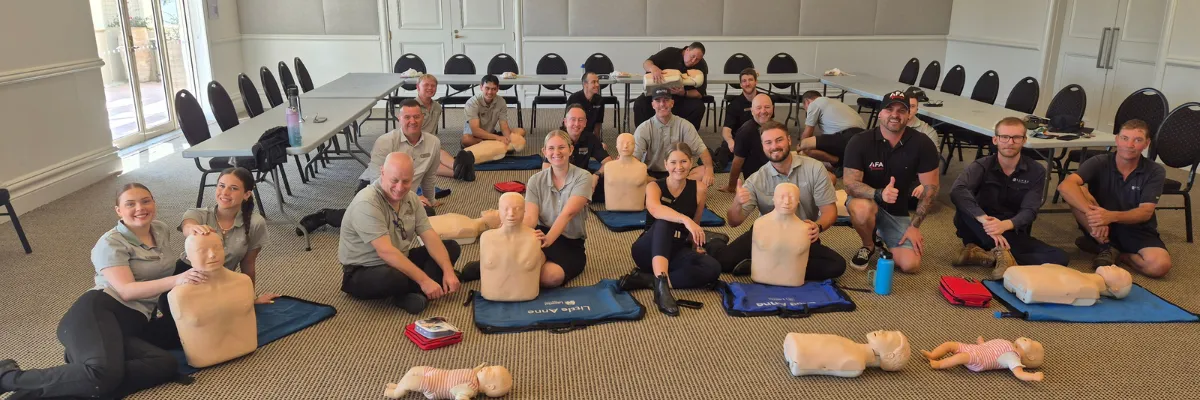
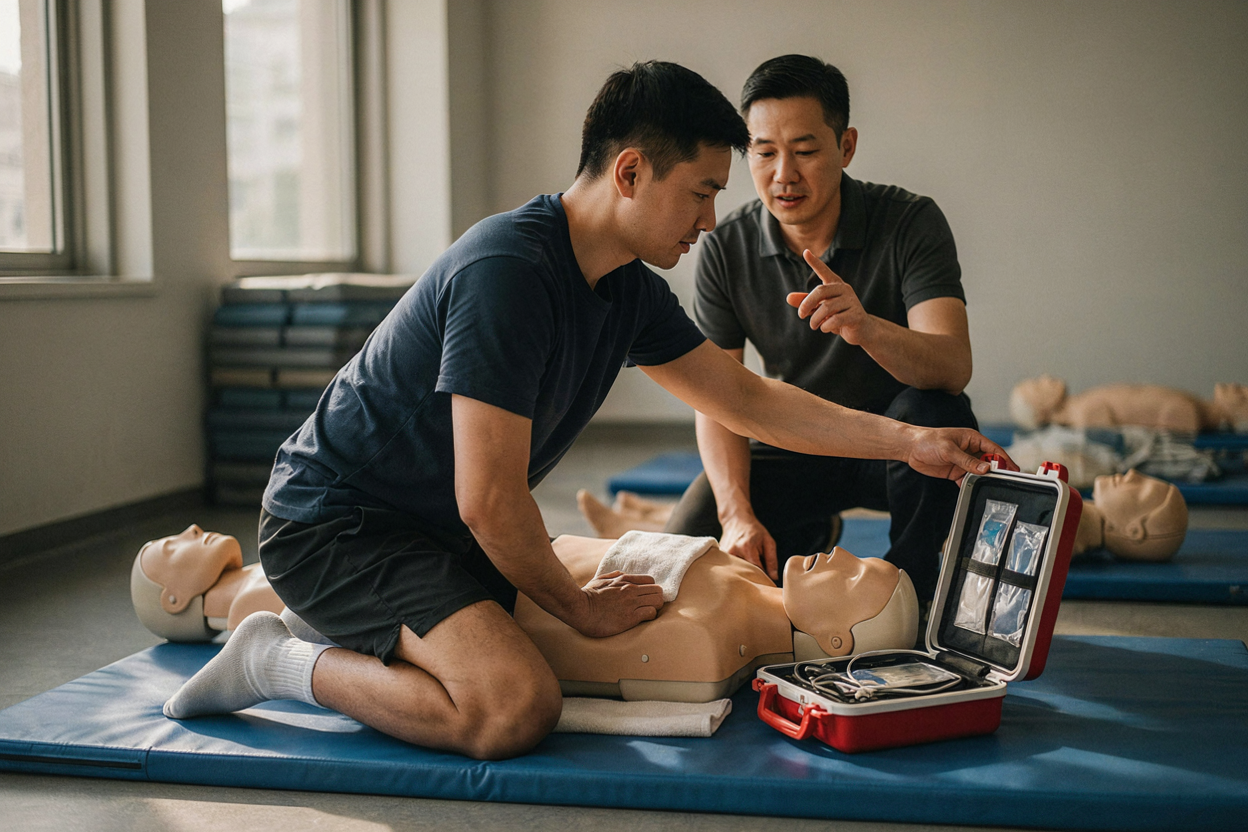
Then it's hands-on: manikin work for compressions and rescue breaths, and practical time with a training AED device, covering pad placement, following the prompts, and delivering a shock on the manikin. The practical assessment is woven through this hands-on component rather than sitting separately at the end, so there's no separate exam-style moment that ramps up the pressure. You're assessed while you're doing the thing, which tends to feel a lot less stressful than a formal test at the finish line.
A fair few people arrive a bit nervous about this part, worried they'll freeze or get it wrong in front of others. That's completely normal, and it's exactly why the hands-on repetition matters so much. Muscle memory does most of the heavy lifting here. By the time you're done, the actions have become instinctive rather than something you're consciously working through step by step, which is exactly the state you want to be in if you're ever actually using these skills for real.
There's no dead time built in here. It's structured so shift workers and tradies can get through it without the day feeling wasted.
Certification, Validity, and Renewal
What you actually walk away with
You'll receive a Statement of Attainment for HLTAID009, and it's nationally recognised. That's an important word, nationally, because it means it's not some in-house certificate that only means something to one employer. It's recognised right across Australia, so if you move jobs, move cities, or move industries entirely, the ticket still counts.
How long it's valid for
ANZCOR and ARC recommend annual renewal for CPR competency. This makes sense when you think about it: CPR is a physical skill, not a fact you memorise once and keep forever. Your technique drifts, guidelines get updated, and a year is roughly the point where going back over it genuinely makes a difference.
Renewing when you're already a student
If you've done this course with Accelerate First Aid before, renewal is generally a faster, lighter process than starting from scratch, since you're brushing up on skills rather than learning them cold. This is really the whole appeal for a lot of people in this position: expired certificate, employer chasing you, no interest in redoing a full day of content you've already sat through. A renewal session is built to respect that.
It's worth being honest about why annual renewal exists at all, rather than just accepting it as a rule. CPR guidelines do genuinely get reviewed and occasionally updated by ANZCOR as new evidence comes in, and a year is enough time for small habits to slip without you noticing. Compression depth creeps shallower, rhythm drifts, and the AED steps that felt automatic six months ago need a reminder. None of that is a personal failing, it's just how physical skills work when they're not used regularly. Renewal exists to catch that drift before it matters.
Once you've completed the practical assessment, here's exactly what you walk away with.
Booking: What to Expect
How to book
Booking is built to be mobile-first and low-friction, because that's how most people are actually finding this course: on their phone, between shifts, on a lunch break. You should be able to see availability and get booked in without creating an account first or jumping through unnecessary steps.
If you've ever bounced off a booking process that wanted your details three times before showing you a session, you know exactly why this matters. A clunky booking form undoes half the promise of the course itself.
If you're still not sure whether this is the right course, this comparison will settle it.
Combined CPR and AED Training vs. Other Course Options
This is probably the single most common point of confusion, so let's sort it out properly.
HLTAID009 (CPR + AED) vs HLTAID011 (Full First Aid)
HLTAID009 (CPR + AED) | HLTAID011 (Full First Aid) | |
Covers | CPR + AED only | CPR, AED, plus broader first aid response |
Best suited to | Roles needing CPR/AED only: fitness, sport, lifeguard, parent | Workplaces requiring broader first aid coverage |
When you'd need the full first aid unit instead
If your workplace needs staff who can handle a broader range of incidents, burns, fractures, wounds, allergic reactions, not just cardiac arrest, then HLTAID011 is the one you actually need, not HLTAID009. A lot of workplaces, especially anywhere with higher general injury risk like trades or larger hospitality venues, require the full unit rather than the CPR/AED-only version.
The simplest way to think about it: HLTAID009 is the CPR and AED ticket specifically. HLTAID011 is that same CPR and AED content, plus a much wider first aid skillset layered on top. If you're not sure which one your job, club or licensing body actually requires, that's worth checking with them directly before you book, since booking the wrong one means doing it all again.
A quick way to sanity-check it yourself: think about what you'd actually be dealing with if something went wrong in your specific environment. A swim coach or gym floor staffer is mostly thinking about cardiac events. A tradie on a job site is also thinking about cuts, burns, fractures and the general chaos of a physical workplace. If your mental list of "things that could go wrong here" stretches well beyond cardiac arrest, that's usually your answer.
Conclusion
If you're staring down an expired certificate and an employer who wants proof by Friday, combined CPR and AED training is built for exactly that situation. It's one session that covers what you actually need, CPR and AED, taught together because that's genuinely how they're used together in a real emergency, not as two separate skills you'd ever apply one after the other.
For a lot of people who book this course, there's more going on underneath the compliance box-ticking than they'd admit out loud. Parents, coaches, aged care workers, they're not just here for a piece of paper. They're here because somewhere in the back of their mind is the thought, "if something happened, would I actually know what to do?" That question doesn't go away with a certificate sitting in a drawer, it goes away when you've actually practised the compressions, actually felt an AED talk you through the prompts, actually worked through the assessment alongside other people doing the same thing.
The confusion between this course and the full first aid unit is real, and it's worth clearing up one more time. If your role or workplace only needs CPR and AED competency, this is the right course, full stop. If you're in an environment with broader injury risk, trades, larger venues, anywhere burns or fractures or allergic reactions are a genuine possibility, the full first aid unit is the one to book instead. Getting this wrong means doing the whole thing again, so it's worth checking before you commit.
Booking itself is meant to be the easy part. Mobile-first, no account creation required, availability visible up front, sessions scheduled around shift work rather than assuming everyone's free on a weekday morning. The certificate side of things, expiry, renewal, what it actually covers, shouldn't be the hard part of your week. Getting booked in shouldn't be either.