Choking First Aid Training: Infant vs Adult Techniques
It happens fast. One second your toddler's sitting there eating a bit of apple at snack time, next second she's gone quiet, eyes wide, hand at her throat, and no sound coming out. Or maybe it's not a toddler at all, it's a mate at footy training who's wolfed down a protein bar between drills and suddenly can't get a word out. Different scene, same gut-drop feeling. What do you actually do in that moment, and does it even matter that one's a baby and one's a grown adult?
It does matter. A lot, actually. The technique you'd use on an infant under 12 months is genuinely different to what you'd do on an adult or older child, and mixing them up isn't just "close enough," it can hurt a fragile little body. That's what choking first aid training is really about, knowing which move fits which person, and being able to do it without freezing.
This guide walks through both, step by step, so whether you're a parent, a coach on the sideline, someone working hospitality, or you're just renewing your CPR ticket for work, you'll know exactly what changes between infant and adult, and what stays the same.
What Is the Difference Between Infant and Adult Choking First Aid?
Here's the short answer, because if you're reading this mid-panic you don't have time for a long one.
Infant (under 1 year) | Adult / Child (over 1 year) | |
Positioning | Face-down along your forearm, head lower than the body | Leaning forward, supported at the chest |
Technique | 5 back blows, then 5 chest thrusts using two fingers | 5 back blows, then 5 chest or abdominal thrusts |
Force used | Gentle, sized to fit the infant | Firmer, full-hand technique |
If unresponsive | Start infant CPR | Start adult/child CPR |
The big things that change are the position you hold them in, how much force you're using, and where exactly on the body you're doing the thrusts. An infant's body is tiny and fragile, so everything gets scaled right down. An adult or older child can take the firmer, full-hand approach.
One line worth remembering above everything else: if the person can't cough, can't cry, and can't breathe, call Triple Zero (000) straight away. Don't wait to see if it resolves on its own.
What Counts as Choking First Aid (and Why Age Changes Everything)
Not every splutter at the dinner table is a full-blown emergency, and knowing the difference is half the battle.
Recognising choking: mild vs severe
If someone's coughing, even loudly and dramatically, that's actually a good sign. It means air is still moving. A mild obstruction usually looks like:
Coughing, even forceful coughing
Able to speak or cry
Able to breathe, even if it's a bit wheezy
Let them keep coughing. That's the body doing its job. Don't jump in and start whacking their back for no reason, you could actually push whatever's stuck further down.
Severe obstruction is a different story entirely. That's when:
They can't cough at all, or the cough is silent
They can't speak or cry
They can't breathe, or they're making a horrible high-pitched noise trying to
Their lips or face start going blue
That's your cue to act, and act now.
Why technique differs by age
An infant's airway is small, soft, and easy to injure. Their ribs are more flexible too, which sounds like it'd make things easier but actually means you have to be more careful, not less, with how much force you use. ANZCOR (the Australian Resuscitation Council) draws a clear line at the 12-month mark: under 1 year, you're doing infant technique. Over 1 year, whether it's a toddler, a teenager, or a grown adult, you're using the adult/child approach, just adjusting the force to suit their size.
Get that age line right in your head first, because everything else builds off it.
Choking First Aid for Infants (Under 1 Year)
This is the one that makes parents' hands sweat just reading about it, so let's slow right down and go through it properly.
Step-by-step
Lay the infant face-down along your forearm, resting on your thigh for support. Their head needs to be lower than their body, gravity's doing some of the work here.
Support their head and jaw with your hand, keeping their airway open, but don't cover their mouth or throat.
Give up to 5 firm back blows between the shoulder blades, using the heel of your hand.
Check their mouth after each blow, if you can see the object, remove it. If not, keep going.
If back blows haven't worked, turn the infant face-up along your forearm, still supported on your thigh, head lower than the body.
Give up to 5 chest thrusts using two fingers only, on the lower half of the breastbone, about the same spot you'd use for infant CPR compressions.
Keep alternating between 5 back blows and 5 chest thrusts until the object comes out or the infant becomes unresponsive.
What NOT to do
Never use abdominal thrusts on an infant. Their organs sit differently and it can cause serious internal injury.
Don't use full adult force. Two fingers, gentle pressure, that's it.
Don't sweep blindly inside the mouth with your finger if you can't see the object, you risk pushing it further in.
If the infant becomes unresponsive
This is the moment everything shifts. Stop the back blows and chest thrusts and begin infant CPR immediately, and get someone to call Triple Zero (000) if you haven't already. Everything you'd learn in a proper infant CPR course kicks in from here.
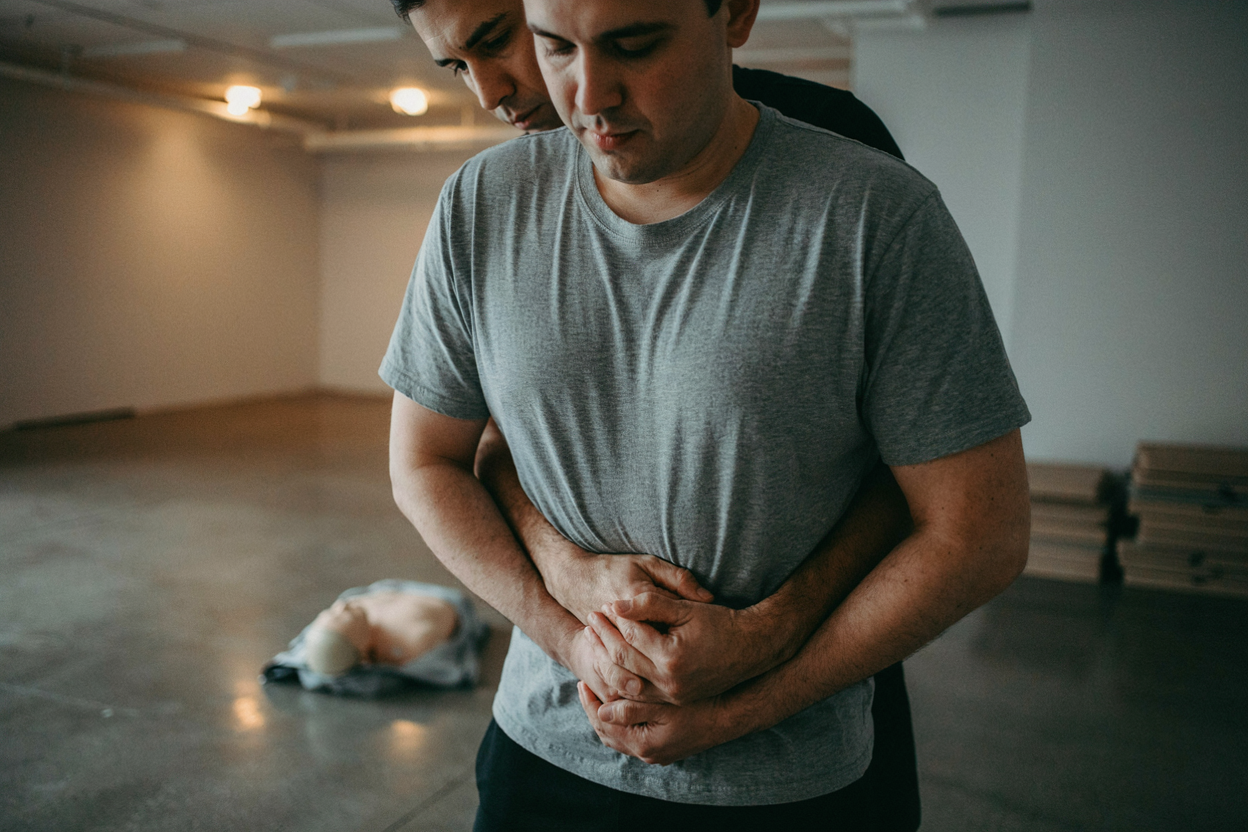
Choking First Aid for Adults & Children (Over 1 Year)
Same principle, bigger person, more force allowed.
Step-by-step
Stand or kneel slightly behind and to the side of the person. Lean them forward so if the object dislodges, it comes out rather than going further down.
Support their chest with one hand.
Give up to 5 firm back blows between the shoulder blades using the heel of your hand.
Check to see if the obstruction has cleared after each blow.
If back blows haven't worked, move to chest or abdominal thrusts. Stand behind them, place your fist just above the belly button, grab it with your other hand, and give up to 5 sharp inward and upward thrusts.
Keep alternating 5 back blows and 5 thrusts until the object clears or the person becomes unresponsive.
Adjusting force for children vs adults
A teenager or full grown adult can handle a firm, decisive thrust, don't be shy about it, a half-hearted attempt won't shift anything. But for a smaller child, you're scaling the force down to match their size, same technique, softer hand. Think of it like the difference between pushing a heavy door open versus a light one, you're using the same motion but not the same effort.
If the person becomes unresponsive
Lower them to the ground carefully, get someone calling Triple Zero (000) if that hasn't happened yet, and start adult/child CPR straight away. Don't keep trying back blows on someone who's gone unresponsive, that window has passed and CPR is what's needed now.
Infant vs Adult Choking First Aid: Side-by-Side Comparison
Worth bookmarking this one, because at the moment your brain won't want to hold two different sets of steps at once.
Infant (under 1 year) | Adult / Child (over 1 year) | |
Positioning | Face-down along forearm, head lower than body | Leaning forward, supported at the chest |
Technique | 5 back blows, then 5 chest thrusts (two fingers) | 5 back blows, then 5 chest/abdominal thrusts |
Force used | Gentle, proportional to infant's size | Firmer, full-hand technique |
If unresponsive | Begin infant CPR | Begin adult/child CPR |
The pattern's the same both ways, back blows first, then thrusts, alternating until it clears. What changes is where your hands go and how hard you're allowed to push. Get the age bracket right and the rest follows.
If you're renewing your ticket or need the full picture properly demonstrated, our HLTAID009 CPR course at acceleratefirstaid.com.au/book-type covers both of these in person, or if you want the broader first aid unit as well, the HLTAID011 first aid course at acceleratefirstaid.com.au/first-aid-course folds this in alongside everything else.

When Choking Becomes an Emergency: What to Do Next
Reading the steps is one thing. Standing there with a purple-faced toddler in your arms is another thing entirely, so let's talk about what actually happens in that moment.
Calling Triple Zero (000)
If the person can't cough, can't cry, can't breathe, someone needs to be dialling 000 immediately, not after you've tried everything else first. If you're on your own, do a short burst of back blows and thrusts first, but get help coming as fast as you possibly can. If there's someone else around, point at them directly and tell them to call, "you, call 000 now" works a lot better than a general shout into the room.
Call Triple Zero (000) immediately if the person can't cough, cry, or breathe.
Moving from choking first aid into CPR
The second the person goes unresponsive, you're not choking first aid anymore, you're doing CPR. That switch needs to happen instantly, no pausing to think about it. This is exactly why hands-on training matters so much, because that switch-over is a muscle-memory thing, not a "let me recall the steps" thing.
Staying calm in that first moment
Nobody feels calm in this situation, and that's fine, you don't need to feel calm, you just need to act. Your hands know what to do if you've trained them. That's really the whole point of this article and the course both, you're not trying to talk yourself into feeling brave, you're trying to build the kind of familiarity where your body just moves.
For the official reference, ANZCOR's choking flowchart and St John Ambulance Australia's guidance are both solid, Australian-specific sources if you want to read further.
Why Hands-On Training Beats Reading a Guide
You've just read the entire process, back blows, thrusts, positioning, all of it. Here's the honest bit though: reading it and doing it under pressure are two completely different skills.
What a guide can't teach you
Muscle memory. Knowing "5 back blows, then 5 chest thrusts" in your head is not the same as your hands already knowing how hard is too hard.
Force calibration. How firm is "firm" on an actual infant mannequin versus an adult one? You genuinely can't learn that from a paragraph, you need to feel it under a trainer's eye.
Confidence under pressure. This is the big one. A course puts you through it enough times that when the real moment comes, you're not googling anything, you're just doing it.
What's covered in the course
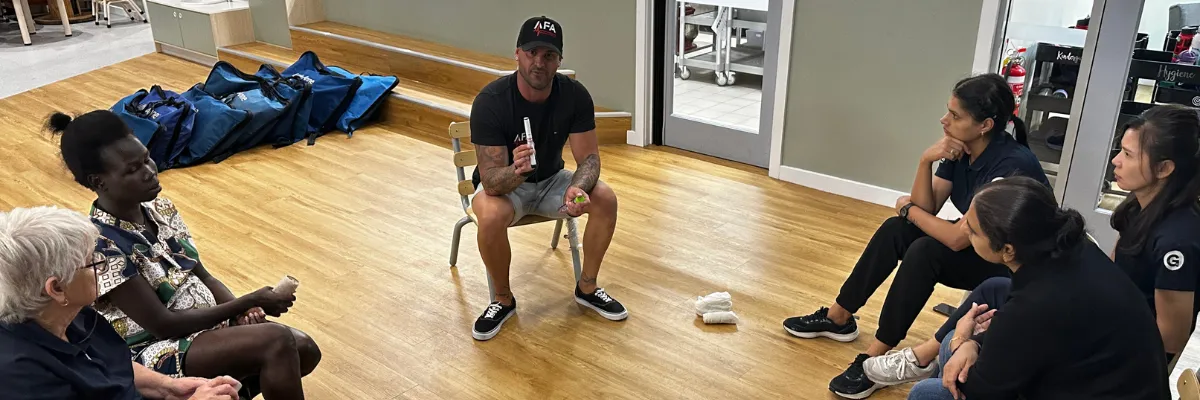
Our HLTAID009 CPR course on the Gold Coast walks you through infant and adult choking response hands-on, alongside CPR, so you're not just ticking a compliance box, you're building the actual skill your employer, club, or your own family is counting on you to have.
Same-week and weekend availability
You're not booking this for fun, you've got a shift roster, a coaching schedule, or a certificate that's about to expire. Sessions run same-week and on weekends across the Gold Coast, so you're not driving across town or taking a full day off to sort this out.
This article gets you informed. The course gets you competent.
Choking doesn't give you much warning, and it doesn't wait for you to remember the right steps in the right order. That's the whole reason age matters so much here, an infant's tiny frame and soft airway need a completely different touch to an adult's, and getting that wrong in the moment can do real harm rather than help. The gap between the two techniques isn't a technicality, it's the difference between a response that actually works and one that doesn't.
For infants under a year old, everything comes back to gentleness and precision, face-down along your arm, careful back blows, then two-finger chest thrusts if those don't clear it. For anyone older, the approach shifts to firmer back blows and chest or abdominal thrusts, scaled to the size of the person in front of you. Both follow the same rhythm underneath, back blows first, then thrusts, alternating until the obstruction clears or the person needs CPR instead.
The moment someone stops coughing, stops crying, stops breathing, is the moment everything changes. That's when Triple Zero needs to be dialled without hesitation, and when choking first aid gives way to CPR without a pause in between. Knowing that switch is coming, and knowing it in your hands rather than just your head, is what separates panic from action.
None of this replaces sitting in a room with a trainer and actually practising it on a mannequin until your hands know the motion without you thinking about it. Reading builds awareness. Practising builds the kind of muscle memory that shows up automatically when your heart's pounding and a real person is in front of you needing help.
Parents, coaches, hospitality staff, renewals ticking a box for work, whoever you are, the goal is the same, walking away knowing you could actually do something useful if this ever happened for real. That's worth more than any certificate on its own.