Top 10 Childcare First Aid Course Scenarios Explained
A toddler goes blue in the face. An infant stops responding. A child with a known allergy takes one bite of the wrong snack, and suddenly you've got seconds, not minutes, to get it right. Every center director knows this fear because it's the thing that keeps her up at night, not the paperwork. That's what makes childcare first aid course scenarios so different from a generic training tick-box, your team needs to know they can handle these exact moments, not just pass a written test.
A certificate proves someone sat through a course. It doesn't prove they'll act when a toddler stops breathing with half the room watching. This guide breaks down the 10 real-world scenarios every childcare first aid course should be preparing your team for, so you can check your team's readiness against them, not just their expiry dates.
Below, we walk through the 10 scenarios your team should handle confidently, from infant CPR to allergic reactions to unresponsive toddlers, plus how to check if your current training actually covers them.
Why Scenario-Based Training Matters More Than The Certificate
Passing HLTAID012 and being ready for a real emergency are two different skills, and the gap between them is where the scary stuff lives.
A certificate says someone learned the steps. It doesn't say they'll remember step three when a two-year-old is choking on a grape and three other kids are tugging at their sleeve. Real emergencies happen mid-lunch, mid-nap transition, mid-outdoor-play, with noise and chaos and half your attention already pulled somewhere else.
Data on how often childcare centers actually encounter first aid emergencies would sit well right here, giving directors a real sense of scale.
Scenario-based training matters more than the piece of paper because it's the difference between an educator who knows the theory and one who's actually rehearsed the moment. So let's walk through the ten scenarios your team needs to master.
The Top 10 Childcare First Aid Scenarios Explained

1. Infant Choking During Bottle or Mealtime
Setup: A baby's on the bottle, or a toddler's working through some soft food, and suddenly they're not swallowing right. Maybe they go quiet, or make a weird high-pitched noise trying to pull air in.
What educators must do:
Check if the infant can cough, cry, or make noise, if yes, let them try to clear it themselves
If not, deliver back blows with the heel of your hand, infant face-down along your forearm
Follow with chest thrusts if back blows don't clear it, and call for backup immediately
Common mistakes:
Picking the infant up and shaking them
Doing adult-style abdominal thrusts on an infant, their body isn't built for that technique
2. Toddler CPR, Unresponsive, Not Breathing
Setup: You find a toddler on the floor, not responding to their name, not moving. The scenario every educator dreads most.
What educators must do:
Check responsiveness first, tap and shout, don't just assume
Open the airway and check for breathing for no more than ten seconds
If not breathing normally, start CPR straight away, 30 compressions to 2 breaths, and send someone to call triple zero
Common mistakes:
Wasting time trying to "wake" the child repeatedly instead of checking breathing
Compressions too shallow, toddlers need real depth, about a third of the chest
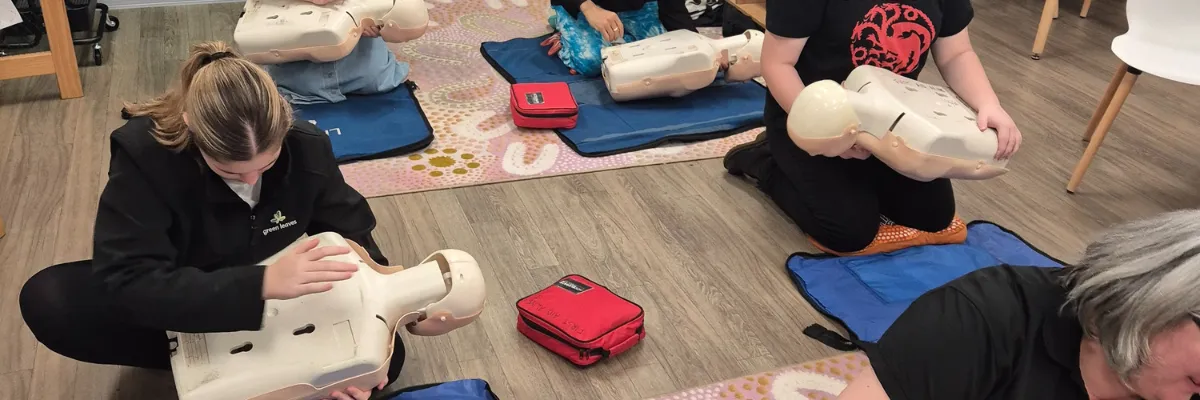
See how this scenario is practiced hands-on in your HLTAID012 course.
3. Anaphylactic Reaction, EpiPen Scenario
Setup: A child with a known allergy has had an accidental exposure. Lips are swelling, hives are breaking out, maybe struggling to breathe.
What educators must do:
Recognize the signs fast, swelling, difficulty breathing, hives, vomiting
Locate the child's medical action plan and EpiPen immediately, administer to the outer mid-thigh
Call triple zero regardless of whether symptoms improve, anaphylaxis can come back
Common mistakes:
Hesitating because the educator isn't "the one" trained on that child's plan
Not calling an ambulance because symptoms seem to settle after the EpiPen
4. Asthma Attack During Outdoor Play
Setup: A child's out running around and suddenly can't catch their breath, wheezing, maybe going pale or a bit blue around the lips.
What educators must do:
Sit the child upright, keep them calm, don't lay them down
Locate their asthma plan and reliever puffer, give four puffs through a spacer if available
Wait four minutes, repeat if no improvement, call triple zero if it's severe or not improving
Common mistakes:
Laying the child down, which makes breathing harder
Not knowing where the puffer is kept, or assuming it's "just asthma" and under-reacting
5. Febrile Convulsion
Setup: A child with a high temperature suddenly starts shaking, eyes rolling, body going rigid. Frightening to watch, and it happens out of nowhere.
What educators must do:
Clear the area around the child so they don't injure themselves
Place them on their side once shaking stops, and time the seizure
Call triple zero if it lasts longer than five minutes, or it's their first seizure
Common mistakes:
Trying to restrain the child's movements
Putting something in the child's mouth, an old myth that still does the rounds
6. Head Injury From a Fall, Concussion Signs
Setup: A child takes a tumble off climbing equipment or knocks their head on the ground. They might seem fine at first, or they might not.
What educators must do:
Assess consciousness and check for bleeding straight away
Apply a cold compress if there's swelling, keep the child calm and still
Watch closely for delayed symptoms, vomiting, drowsiness, confusion, and notify parents with clear detail
Common mistakes:
Assuming the child's fine because they got straight back up
Missing delayed symptoms because nobody's assigned to keep checking later
7. Ambiguous Symptoms, Asthma vs. Anaphylaxis vs. Choking
Setup: The curveball. A child's struggling to breathe, but there's no known allergy on file, no asthma diagnosis, and nobody saw what triggered it.
What educators must do:
Look for distinguishing signs, hives and swelling point to anaphylaxis, wheeze without swelling points to asthma
Check the child's records fast for any known conditions
When in doubt, treat as the more severe possibility and call triple zero
Common mistakes:
Freezing while trying to work out exactly which condition it is
Ruling something out too quickly because "they've never had a reaction before"
See how this differential-assessment scenario is practiced hands-on in your HLTAID012 course.
8. Severe Bleeding / Laceration
Setup: A child's cut themselves on play equipment or fallen onto something sharp, with a lot more blood than a standard scraped-knee situation.
What educators must do:
Apply firm, direct pressure with a clean dressing, don't lift it to check
Elevate the injured area above heart level, add more dressings on top if blood soaks through
Call triple zero for deep wounds, embedded objects, or bleeding that won't slow
Common mistakes:
Peeking under the dressing to "check," which breaks the clot forming underneath
Applying a tourniquet when direct pressure would have done the job
9. Burns, Hot Water, Playground Equipment
Setup: A child's grabbed something hot, or touched playground equipment that's gotten far hotter than it looks sitting in the sun.
What educators must do:
Run cool running water over the burn for twenty minutes, straight away
Remove any jewelry or tight clothing near the area before swelling starts
Cover loosely with a clean, non-stick dressing, never ice or butter or any home remedy
Common mistakes:
Using ice, which can damage the skin further
Not cooling for long enough, or popping blisters
10. Multiple Casualty / Split-Attention Scenario
Setup: The ratio-pressure scenario. One child's had a fall while another's mid-asthma-attack, and you've only got one qualified first aider in the room.
What educators must do:
Do a fast triage, work out which situation is more time-critical
Call for backup immediately, delegate so someone watches the less urgent child
Communicate clearly to whoever's coming to help, so there's no confusion on arrival
Common mistakes:
Trying to handle both situations solo instead of delegating
Freezing while deciding who to help first

How To Check If Your Team Is Actually Ready, Not Just Certified
A stack of valid certificates feels reassuring, but it's not the same question as "would my team actually nail scenario six if it happened tomorrow." Here's a simple self-audit.
Ask yourself:
Could every educator name the location of the EpiPens and asthma puffers without hesitating?
Has anyone actually practiced infant back blows and chest thrusts recently, or just watched it on a screen?
Do your newer hires know your center's specific medical action plans, or just the generic theory?
If two things went wrong at once, does your team know who'd triage and who'd delegate?
When did anyone last talk through Scenario 7, the ambiguous one, out loud as a team?
If you're hesitating on more than one or two of those, that's not a failure on your part, it's just what happens with turnover and time.
Ratio compliance under the NQF isn't just about having the right number of certified staff on paper, it's about knowing that staff can genuinely respond.
Want to see if your team's scenario-ready? Download our free Scenario Readiness Checklist.
What Happens If Your Team Isn't Prepared
Nobody wants to think about this part, but it's worth sitting with, because it's exactly what drives the anxiety so many directors carry around quietly.
An ACECQA assessor doesn't just check that certificates exist. They're looking at whether your center can genuinely respond in a real emergency, and gaps become a finding against your center.
Beyond the regulatory side, there's the parent trust piece. Word travels fast among Director networks and parent groups. One fumbled response can follow a center for a long time.
And underneath all of that sits the thing that matters most: an educator who freezes in a real moment carries that with them long after. Being prepared protects your team from that kind of guilt too.
Building Scenario Confidence Through Refresher Training
HLTAID012 doesn't last forever, and neither does the muscle memory that comes with it. Skills fade when they aren't practiced regularly.
This is where HLTAID009 refresher training earns its place as the ongoing solution, rather than something squeezed in only when a certificate's about to lapse. Think of it as keeping the muscle memory from fading between HLTAID012 renewal cycles.
A good refresher walks your team back through the scenarios that matter most, infant CPR, EpiPen use, the ambiguous-symptoms judgement call. And refreshers are built to fit around your ratios, staggered sessions, nobody pulling the whole floor off duty at once.
Keep your team scenario-ready year-round with HLTAID009 refreshers.
Conclusion
A certificate tells you someone sat through a course and passed an assessment. It doesn't tell you whether that person will remember what to do when a toddler goes quiet mid-meal, or a child's lips start swelling mid-play. That gap between "certified" and "ready" is the whole reason scenario-based training exists.
The ten scenarios walked through here aren't random. Choking, unresponsive toddlers, anaphylaxis, asthma, febrile convulsions, head injuries, ambiguous symptoms, bleeding, burns, and managing two emergencies at once with only one first aider on the floor, these are the actual moments that happen in real centers, not theoretical exam questions.
What makes this harder is turnover. The moment a team feels solid, someone resigns, someone new starts, and the clock on readiness resets. The centers that stay ahead of it treat scenario confidence as something to keep topped up, not tick off once and forget.
Ratio pressure makes this harder still. Pulling multiple educators off the floor for training risks breaching the very ratios first aid certification exists to protect. That tension is why staggered, ratio-aware training matters more than a generic course.
None of this is about frightening anyone into action. It's about being honest that a real emergency demands a response instantly, often with other children still needing supervision at the same time. The centers that handle these moments well aren't lucky, they're the ones who rehearsed it beforehand, calmly, so the real moment doesn't feel like the first time.
This isn't really about compliance at all, even though compliance sits underneath it. It's about an educator feeling steady enough to act without hesitation, and a director walking into her center each morning genuinely confident her team is ready. That confidence is the actual goal. The certificate was only ever meant to be the paperwork trail behind it.