Can You Fail a First Aid Course in Australia? The Truth
What happens if you freeze on the manikin? What if you can't remember the compression ratio? What if you just... fail?
If you Googled something like "can you fail a first aid course" before clicking this, you're not alone. Most people who are about to book their first aid course have exactly that question sitting at the back of their mind — and it's a completely reasonable one. Maybe you haven't done a course in years and you're worried the knowledge has gone. Maybe you've never done one at all and you genuinely don't know what to expect. Either way, that quiet anxiety before a course is real, and it's worth addressing head-on before you walk through the door.
Here's the short answer: first aid courses in Australia aren't designed to catch you out. They're built to get you over the line. But there are a handful of ways you can leave without your certificate on the day — and knowing what they are makes the whole thing a lot less stressful.
By the time you're done reading this, you'll know exactly what gets assessed in an HLTAID011 and related courses, what the term "not yet competent" actually means (it's not a fail), how reassessment works, and what you can do to walk in confident. We're going to cover how the assessment is structured, what trainers are actually looking for, and what happens in the rare situation where someone needs a bit more practice before they get signed off.
Can You Fail a First Aid Course in Australia?
Technically, yes - but the word "fail" isn't actually used. Australian first aid courses run on a competency-based model, which means there's no score, no percentage, and no pass mark. You either demonstrate the required skills to your trainer's satisfaction, or you need a bit more practice before your certificate gets issued. That's it.
The formal term is "not yet competent" — and it's very different from failing a test at school. It just means one element needs another look before you're signed off.
The vast majority of participants complete their course and walk out with their certificate on the same day.
What assessors are actually looking for:
Correct CPR compression rate and depth on the manikin
Proper airway management and rescue breaths
Correct use of an AED (Automated External Defibrillator)
Appropriate response to scenario-based practical tasks — choking, bleeding, unconscious patient
Completion of the written knowledge assessment (short answer or multiple choice)
If a participant doesn't hit the mark on one of those elements, most RTOs will offer a same-day reassessment. You work through it with your trainer and get another go — usually within the same session.
To understand why not getting your certificate on the day is rarer than most people think, it helps to understand how the assessment is actually structured.
How First Aid Assessment Actually Works in Australia
Every ASQA-registered RTO in Australia including Advanced Resuscitation Training — delivers first aid training under a competency-based training (CBT) model. That's the national framework. There are no grades. No rankings. No one's comparing your performance to the person next to you.
The only question your trainer is asking is: has this person demonstrated they can do this safely and correctly?
HLTAID011 sits within the HLT Health Training Package, which is regulated by ASQA. The clinical standards for CPR — compression rate, depth, technique — are set by the Australian Resuscitation Council. So when a trainer assesses your CPR, they're not using their personal opinion. They're working against a published, nationally consistent standard.
There are two components to the assessment.
The Practical Skills Assessment
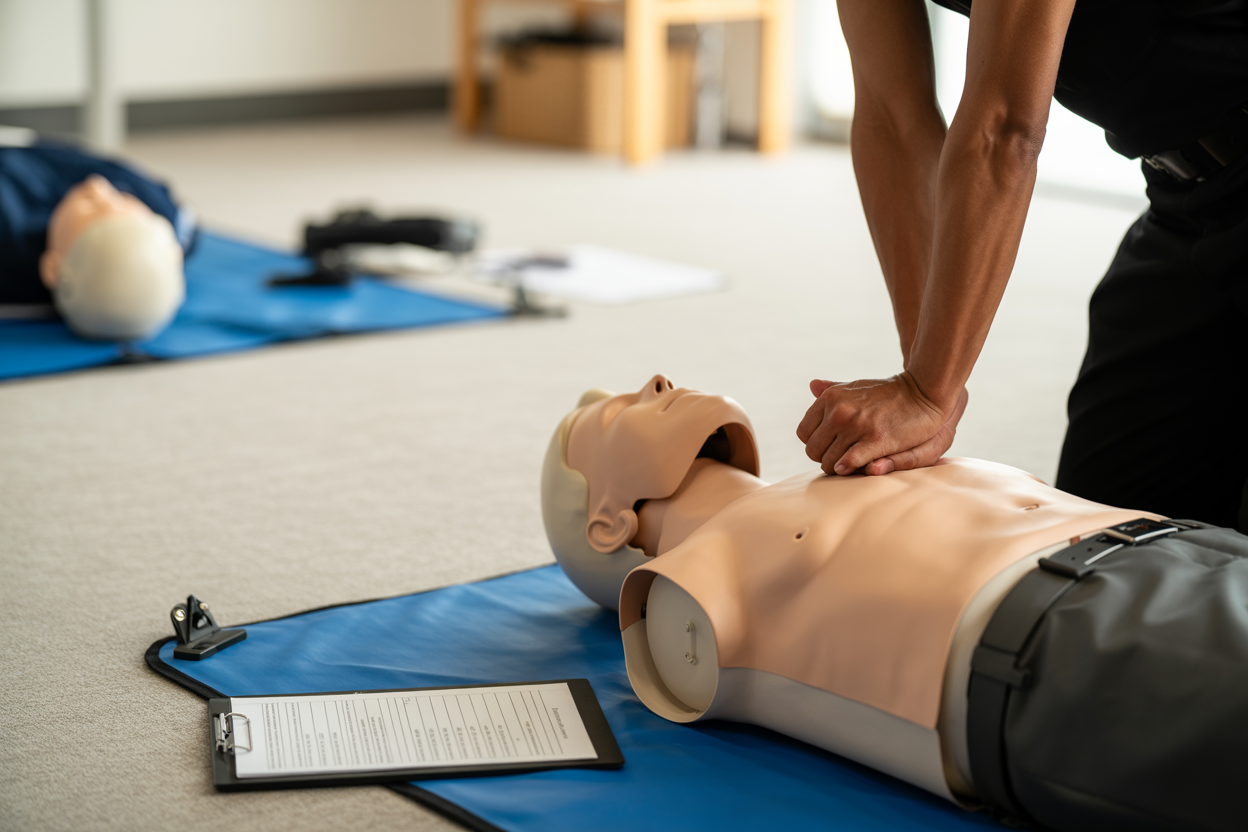
This is the hands-on part. You'll work through CPR on an adult manikin, infant CPR, AED operation, the recovery position, and scenario responses covering situations like choking, bleeding, and anaphylaxis.
For CPR to be marked competent, you need to be hitting a compression depth of around 5–6cm, a rate of 100–120 compressions per minute, correct hand position, full chest recoil between compressions, and adequate rescue breaths. Those numbers come directly from ARC Guideline 7.
That sounds precise — and it is — but your trainer isn't standing there with a stopwatch making millimetre measurements. They're looking at whether you've got the technique right and whether you're in the right ballpark. Most people get there.
The Knowledge Assessment
This is the written component. It tests whether you understand when and how to act — not whether you've memorised obscure clinical facts. This is not a university exam. Many RTOs allow you to use reference materials during this part. The questions are practical: what do you do if someone is unconscious and not breathing? What's the first thing you check before approaching a scene?
So what actually happens in the minority of cases where someone doesn't demonstrate competency on the first attempt?
What Happens If You Don't Meet the Standard on the Day
"Not yet competent" — NYC — is the formal language RTOs use. Not fail. Not incorrect. Not wrong. NYC just means: not yet. There's more work to do, and it's doable.
When a trainer identifies an NYC outcome on a specific element, they'll tell you what the gap is, show you what needs to be different, and give you the chance to have another go. That reassessment usually happens the same day — often within the same session, once you've had a few more minutes of practice and guidance.
You won't receive your certificate until every component is marked competent. But that's not a dead end. It's a process.
Common Reasons Participants Need Extra Practice
CPR compression depth or rate outside the required range — usually because the participant is going too fast or not pressing firmly enough
Forgetting to check for dangers before approaching a scene — it's the first step, and nerves can knock it out of your head
Incorrect infant CPR technique — the two-finger compression and different ratio catch people out, especially if they've only practized adult CPR before
Incomplete scenario response — missing a key step like calling 000
A knowledge assessment question that needs clarification or another attempt
What a Reassessment Looks Like
It's not a full repeat of the course. Your trainer goes back to the specific element that wasn't demonstrated to standard, works through it with you, and then reassesses just that part. If you needed extra time on compression rate, you practice compression rate. That's it. Most of the time this is sorted within the same session and you go home with your certificate.
Knowing reassessment exists is reassuring — but most people want to know: is this likely to happen to me?
Who Is Most Likely to Need Extra Practice And Why It's Nothing to Worry About
There are three types of people who tend to need a bit more time on the day. None of them are unusual. All of them get there.
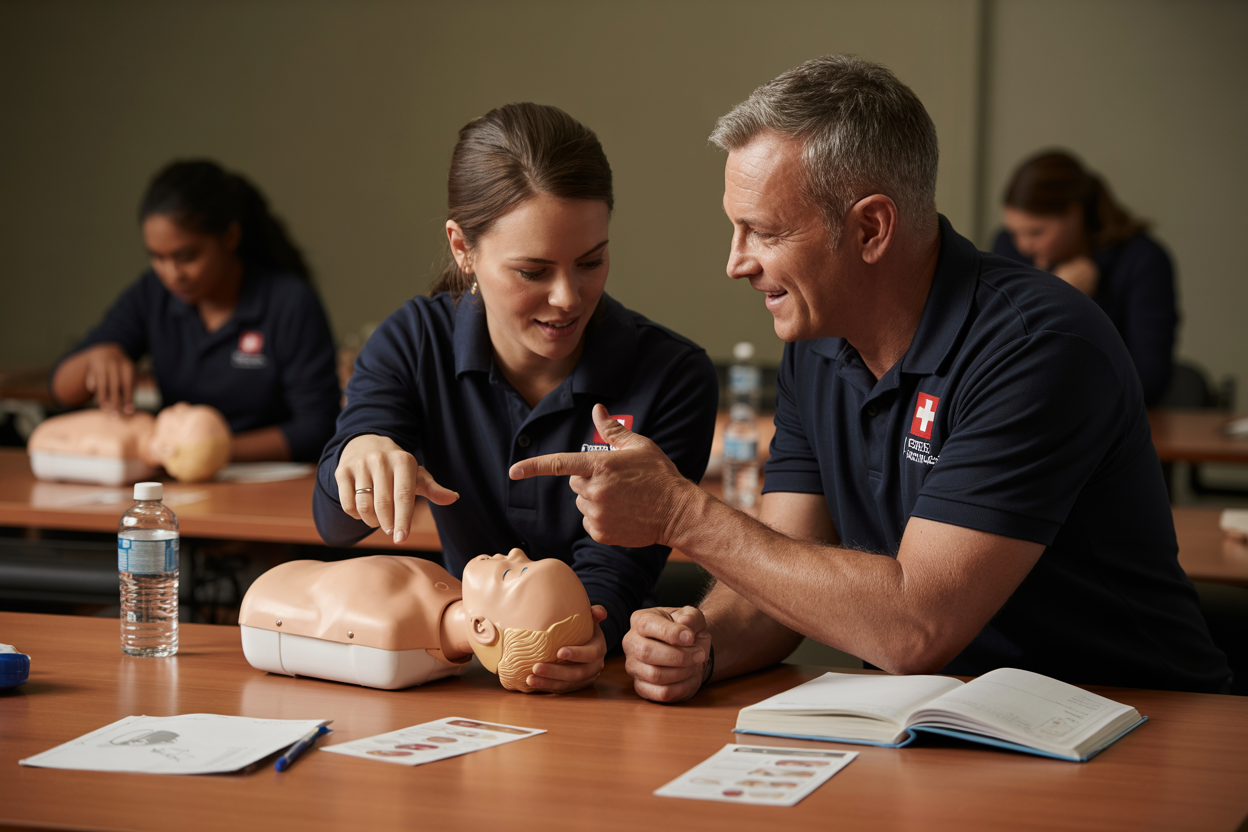
First-timers - if you've never pushed down on a manikin before, the compression depth feels strange. You're not sure if you're doing it right. You second-guess yourself. Your rate drifts. This is completely normal and trainers expect it. The first few minutes on the manikin are always an adjustment, and a good trainer is watching for this and correcting it before it becomes an issue.
Long-lapsed participants - if your last course was several years ago, the knowledge is probably still there but the muscle memory has faded. Your brain remembers doing CPR. Your hands aren't sure. The practical confidence comes back quickly with a bit of time on the manikin, but it might take a couple of rounds before everything clicks.
Anxious learners - test anxiety is real, and performing a skill in front of a trainer and other participants adds pressure that simply isn't there when you're watching a YouTube video at home. Good trainers know this. The best training environments are low-pressure, conversational, and focused on getting you across the line not on catching you out.
Tips to Walk In Confident
Watch a short CPR technique video the night before — the ARC website and St John Ambulance both have solid resources
Get a good night's sleep — physical technique suffers when you're tired, more than your knowledge does
Arrive a few minutes early — settling in before the session starts takes the edge off
Ask your trainer questions — there are genuinely no stupid questions in a first aid course
Remember: your trainer wants you to leave competent; it reflects on them just as much as it does on you
The good news is the same supportive model applies whether you're doing a CPR-only course or the full first aid qualification.
Does It Matter If You're Doing HLTAID009, HLTAID011, or HLTAID012?
Not when it comes to how the assessment works. The competency-based model is consistent across all three units. What changes is the scope of what's being assessed.
If you're a childcare worker doing HLTAID012, you'll have more paediatric scenario content than someone doing HLTAID011 — but the process is the same. Demonstrate the skills. Get signed off. Receive your certificate. Not sure which unit you actually need? Use our course selector to find the right fit before you book.
For most people, the preparation tips above are more than enough. But if you have specific concerns going in, here's what to know.
What to Do If You're Genuinely Struggling
Sometimes the barrier to completing a first aid course isn't technique or knowledge — it's something else.
Physical limitations can make certain practical elements difficult. English as a second language can make the knowledge assessment harder to interpret. Learning difficulties or high anxiety can affect performance in ways that have nothing to do with a person's actual capability. These are real situations and they happen regularly in first aid courses across Australia.
Under the Standards for RTOs 2015, registered training organisations have obligations around reasonable adjustment — which means making appropriate changes to how assessment is delivered so that the barrier is removed without compromising the standard being assessed. That might mean extra time on the knowledge component, a verbal assessment instead of written, or a modified approach to a practical task.
If any of this applies to you, the best thing you can do is call before you book. Not to ask permission — just to have a conversation. A good RTO will walk you through exactly what to expect and work out what adjustments, if any, make sense for your situation.
"If you have any concerns about the assessment before you book, call our team — we'll walk you through exactly what to expect."
Ready to Book Your First Aid Course?
Our trainers support every participant through the assessment process — from first-timers who've never touched a manikin, to workers refreshing after years away. ASQA-registered.
Check the course calendar online, pick a session that works for your schedule, and book your spot with instant confirmation. Show up on the day and your trainer will guide you through every step of the assessment — and when you're done, your certificate is issued the same day.