Blended First Aid Course: Learn Online, Then Train Hands-On
A job offer that says "current HLTAID011 required" usually comes with a start date. And that date doesn't move.
For most people the hard part isn't the course itself. It's finding a whole weekday to sit in a training room while work, childcare and everything else keeps going without you.
A blended first aid course fixes that. You do the HLTAID011 Provide First Aid theory online, on your phone, whenever it suits. Then you come in for a shorter hands-on practical, where a trainer checks your CPR, bleeding control and emergency response skills in person. It's the same nationally recognised HLTAID011 your employer asks for, and CPR's included in it too. Honestly, for anyone juggling a new job and a busy house, it's the way we'd point you.
This guide walks through how blended first aid training works, what actually happens at the practical, and how quick your certificate turns up. Plus what to check before you book, so you don't end up paying for a course your employer won't accept.
How Does a Blended First Aid Course Work?
A blended first aid course splits HLTAID011 Provide First Aid into two parts: theory you do online at home, then a shorter face-to-face practical where a trainer assesses your skills in person.
Book your practical session. Pick a date that fits your week.
Log in to online learning. Work through the theory on your phone or computer, at your own pace.
Finish the online assessment. Get the theory done before your practical day.
Attend the hands-on practical. Your trainer assesses adult and infant CPR, AED use, bleeding control and emergency response.
Get your certificate. Pass both parts and your nationally recognised HLTAID011 certificate gets emailed the same day.
That's the whole thing in five steps. The online part is where most of the learning happens, so that's where we'll start.
What You Do in the Online Part of Your First Aid Course
The online part is where you learn the theory, so the what-to-do and the why, before you ever get near a manikin. It all happens through an online portal, which means your online first aid theory can get done from the couch, the car park at daycare pickup or the lunch room at work.
What the online modules cover
The modules cover everything you'll put into practice on the day:
The DRSABCD action plan
CPR and AED theory
Bleeding, burns and fractures
Choking
Seizures
Asthma and anaphylaxis basics
Shock
Legal duty of care and incident reporting
If you've got little ones at home, the choking and seizure modules hit a bit closer to home. Honestly, they're the ones worth slowing down on.
Doing it on your phone
If you get stuck, or a question trips you up, give the team a call on 0434 778 243. Nobody expects you to know it all before you start. That's the whole point of the course.
You can see the full unit details on our HLTAID011 Provide First Aid course page.
Once the theory's done, the rest happens in one shorter session in the room.

What Happens at Your Practical Session
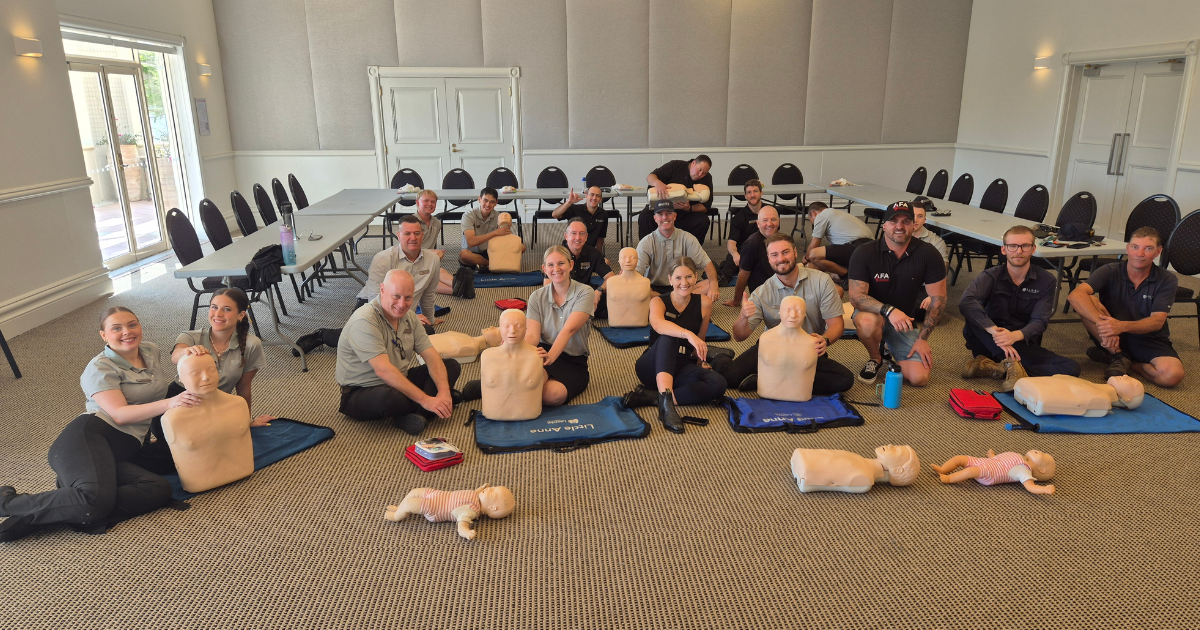
Your practical session is where you show your trainer you can actually do the skills you learned online. Hands on, on the floor, with real equipment. This is the bit most people get nervous about, so let's walk through it properly.
The skills your trainer assesses
Your first aid practical assessment covers:
CPR on adult and infant manikins, on the floor
AED operation
Bleeding control and bandaging
The recovery position
Choking response, using back blows and chest thrusts in line with ANZCOR guidelines
Responding to a scenario, like you would if it happened for real
It sounds like a lot written down. In the room it flows pretty naturally, because each skill builds on the last one.
What to wear
Nervous about the assessment? Here's what it's really like
You're not performing for a crowd. You practise every skill before you're assessed on it, and your trainer talks you through it as you go. If something's not clicking yet, you get more practice before you're signed off. Nobody's trying to catch you out.
Kneeling for CPR is part of the national unit requirements, so it can't be skipped. But if you've got a sore knee, a bad back or anything else going on, give the team a call before you book on 0434 778 243. It's much easier to talk it through beforehand than worry about it on the day.
Is a Blended First Aid Certificate the Same as a Full-Day Course?
Yes. HLTAID011 blended delivery gives you the exact same unit and the exact same certificate as sitting a full day in a classroom. The only thing that changes is where you do the theory.
Blended | Full-day face-to-face | 100% online "certificate" | |
Unit issued | HLTAID011 | HLTAID011 | Often none, or not accepted |
Practical assessed in person | Yes | Yes | No |
Accepted by employers | Yes | Yes | Usually rejected |
Why your employer will accept it
Accelerate First Aid delivers under RTO 31106, and HLTAID011 is a nationally recognised unit. Your employer can look up both on training.gov.au, and you can check HLTAID011 on training.gov.au yourself too. That's the stuff onboarding teams care about, not whether you learned the theory at a desk or on your couch.
Why a 100% online first aid certificate isn't the same
First aid is a hands-on skill. To earn HLTAID011, you have to actually show you can do CPR, use an AED and control bleeding while someone qualified watches you do it. You can't tick that box by clicking through slides, which is why a lot of cheap online-only "certificates" get knocked back.
Some providers run the practical over Zoom and post you a manikin kit. That's a different setup from blended first aid training with an in-person practical, and it's not automatically invalid. If you're looking at one, just check with your employer first that they'll accept it. Better a quick email now than redoing the course later.
Knowing the certificate is the same, the next question is whether HLTAID011 is the one your job actually needs.
Which First Aid Course Does Your Job Need?
For most jobs that ask for first aid, HLTAID011 Provide First Aid is the one. The codes get confusing fast, so here's the short version. HLTAID011 already contains HLTAID009 (CPR) and HLTAID010 (Basic Emergency Life Support). They're not competing courses. They're the building blocks inside the one you're booking.
Role | Usual requirement | Notes |
NDIS / disability support | HLTAID011 | Some providers also ask for asthma and anaphylaxis |
Aged care | HLTAID011 | Check employer onboarding list |
Fitness / personal training | HLTAID011 or HLTAID009 plus CPR | Check your registration body |
Hospitality / retail | HLTAID011 | Workplace first aider role |
Trades / construction | HLTAID011 | Site induction requirement |
Childcare / OSHC | HLTAID012 plus ACECQA-approved anaphylaxis and asthma training | Ask us about HLTAID012 |
Before you book, check your employer's onboarding list. If it names a code, match that code. It's the quickest way to stop second-guessing yourself at 10pm.
If you're starting disability support work, a first aid course for NDIS workers is usually just HLTAID011, with asthma and anaphylaxis on top if your provider asks for it.
Does HLTAID011 include CPR?
Just after CPR on its own, maybe for a yearly refresher? We run an HLTAID009 CPR course too.

How Fast You Get Your Certificate, and How Long It Stays Current
Your certificate is emailed to you the same day you pass both parts, so you're not left waiting on a "coming soon" while your start date gets closer.
Same-day certificate
Once you've passed the online theory and the practical, your same day first aid certificate lands in your inbox as a PDF. You can forward it straight to your employer's onboarding team that night, and that's one less thing hanging over your first week.
When to refresh your first aid and CPR
Workplace first aid codes of practice recommend you renew your first aid every 3 years and refresh your CPR every year.
CPR is a skill that fades if you don't use it, so a quick yearly refresher keeps your hands remembering what to do. It also keeps you rosterable, and if you're picking up casual shifts that matters more than you'd think. Pop a reminder in your phone so it doesn't sneak up on you. In the future you will be glad you did.
How to Check a Blended First Aid Provider Before You Book
A good blended first aid provider makes the important stuff easy to find. If you have to dig for it, that tells you something. Run any provider through this list before you hand over your card details.
🚩 Provider checklist
☐ RTO number you can find on training.gov.au, with HLTAID011 on their scope
☐ Practical assessed in person, or a virtual option that's clearly explained
☐ All-in price, with no add-on fees for the certificate or the online access
☐ Dates listed publicly, not hidden behind an enquiry form
☐ Certificate turnaround stated plainly, in actual words, not "soon"
☐ Recent Google reviews from local learners
The RTO check is the big one. Search the provider's RTO number on training.gov.au and look for HLTAID011 on their scope. If it's not there, the certificate won't be either.
Hidden fees are the next one people get caught on. A course that looks cheaper can end up costing more once a "certificate fee" or "portal access fee" sneaks in at checkout. And if you can't see a single date without filling in a form first, that's usually a sign the booking process will be just as slow.
Reviews are worth a scroll too. Look for ones from people who did the course recently and mention things you care about, like how the practical felt or how quick the certificate came through.
Book a Blended First Aid Course with Accelerate First Aid
You can book a blended first aid course with Accelerate First Aid on your phone, without filling in an enquiry form first. And it ticks every box on that checklist, starting with RTO 31106 and HLTAID011 on scope.
Your online learning, practical session and certificate are all included, with no extra fees popping up at checkout. Pick whichever session fits around work, daycare and the rest of your week.
Your practice is run by Jarryd Hunter, who comes from a paramedic background. He'd much rather you ask the "silly" question in the room than wonder about it later on the job.
Booking is quick. Pick your practical date, and your online learning login arrives by email. Work through the theory on your phone over a few evenings, come in for your hands-on session, and your HLTAID011 certificate lands in your inbox the same day, ready to send to your new employer.