Asthma and Anaphylaxis Treatment Steps Australia Explained
It's a Tuesday morning in September. A child in your room starts coughing, then wheezing. Her reliever puffer is in her bag. You reach for it. And then your mind goes completely blank.
Not because you don't care. Not because you haven't done the training. But knowing what to do and being able to execute it calmly, correctly, in the right order, while a room full of children is watching, are two completely different things.
Most childcare educators have sat through asthma and anaphylaxis training at least once. Far fewer feel genuinely confident they could work through the correct asthma and anaphylaxis treatment steps Australia-wide protocols require, under real pressure, without hesitating. This guide covers the 4x4x4 rule, the anaphylaxis treatment sequence, how the two conditions overlap, how to read an ASCIA Action Plan, and how 22300VIC and 22556VIC training builds the muscle memory behind these steps.
What Is Anaphylaxis and Why Speed Is Everything
Around 20 Australians die from anaphylaxis every year, and research from ASCIA consistently points to the same contributing factor: delayed or incorrect treatment. Not the allergy itself. The response to it. What you do in the first few minutes matters more than almost anything else.
What Triggers Anaphylaxis in Children?
Anaphylaxis isn't just a bad allergic reaction. It's a systemic immune response, meaning the body's immune system overreacts so severely that it affects multiple organ systems at once. Airways can swell. Blood pressure can drop. The whole thing can escalate faster than most people expect.
In childcare settings, the most common triggers are:
Peanuts and tree nuts
Dairy and eggs
Insect stings (bees and wasps, especially in outdoor play areas)
Latex (gloves, balloons)
Some medications
Around 1 in 20 Australian children has a food allergy. In a room of 20 kids, at least one of them is likely at risk.
How Quickly Does Anaphylaxis Progress?
Anaphylaxis can progress from first symptoms to life-threatening within 5 to 30 minutes of exposure. The instinct to "wait and see if it gets worse" is one of the most dangerous decisions an educator can make. Anaphylaxis hospitalizations in Australia have increased fivefold over the past 20 years according to ASCIA, and the response has to match that reality.
The Difference Between a Mild Allergic Reaction and Anaphylaxis
This is the knowledge gap that causes the most anxiety for educators, and rightly so. Here's how to tell them apart:
The key distinction is whether the reaction is affecting breathing, circulation, or consciousness. If it is, that's anaphylaxis. A child with hives is not the same situation as a child who's struggling to breathe and can't stay upright. Only one requires an EpiPen and a call to Triple Zero.

What Are the Steps for Treating Anaphylaxis in Australia?
In Australia, anaphylaxis treatment follows the ASCIA Action Plan for Anaphylaxis. These are the correct steps, in order:
Lay the person flat, do not allow them to stand or walk. If breathing is difficult, allow them to sit up slightly.
Administer the adrenaline injector (EpiPen) injected into the outer mid-thigh, through clothing if necessary. Hold for 10 seconds.
Call Triple Zero (000) states clearly that the person is having anaphylaxis.
Note the time of the injection for the paramedics.
Administer a second EpiPen after 5 minutes if there is no improvement.
Begin CPR if the person becomes unresponsive and is not breathing normally.
Always follow the individual child's written ASCIA Action Plan where one exists.
How to Use an EpiPen: Step-by-Step
The outer mid-thigh is the only correct injection site, not the upper arm, not anywhere else. The outer mid-thigh has a large muscle mass close to the surface, which means the adrenaline absorbs quickly and reliably.
You don't need to remove clothing. The EpiPen can be administered straight through fabric, which matters when seconds count and you're dealing with a child who is distressed or losing consciousness.
The technique itself: remove the blue safety cap, press the orange tip firmly against the outer mid-thigh, hold until you hear a click, then continue holding for a full 10 seconds. When you withdraw, massage the injection site briefly. The click confirmation is important. It tells you the mechanism has fired.
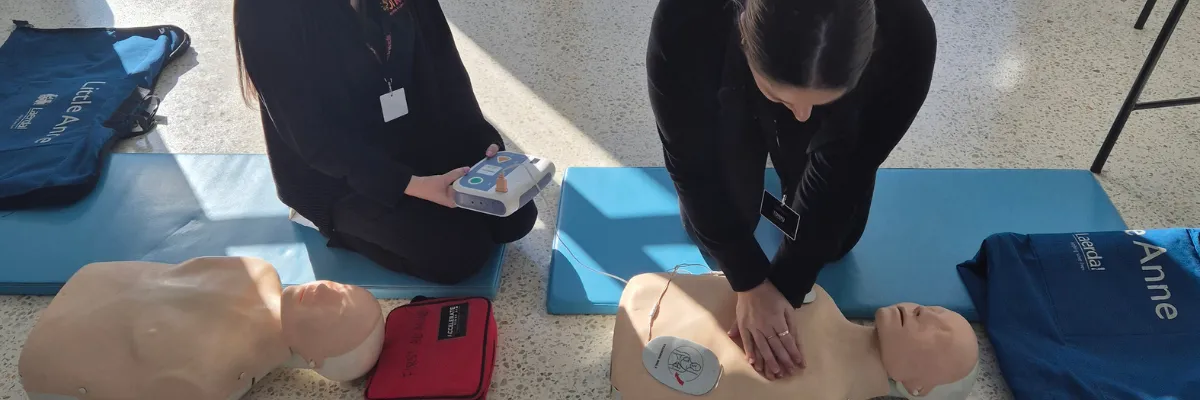
Ten seconds feels longer than you think when a child is in front of you. Practicing with an EpiPen trainer device is what builds the muscle memory that stops you second-guessing.
What to Do While Waiting for the Ambulance
While waiting for Triple Zero to arrive, keep the child flat and do not let them stand or walk even if they say they feel better, do not offer food or drink, do not leave them alone, monitor breathing continuously, and be ready to commence CPR. Adrenaline is fast-acting but not always permanent. Symptoms can return (a biphasic reaction), which is why every anaphylaxis case requires paramedic assessment regardless of apparent recovery.
Can You Give a Second EpiPen?
Yes. ASCIA guidelines allow a second adrenaline injector dose after 5 minutes if there is no improvement. Most centers managing children with severe allergies keep two EpiPens on-site. If the first dose hasn't produced visible improvement, administer the second. The risks of administering adrenaline when it may not be strictly necessary are far lower than the risks of withholding it.
Asthma First Aid Steps in Australia: The 4x4x4 Rule
Asthma is the emergency educators are most likely to actually face. The Australian asthma first aid protocol is straightforward once you know it.
What Is the 4x4x4 Rule for Asthma?
The 4x4x4 rule is the standard asthma first aid response in Australia, endorsed by Asthma Australia and consistent with current national guidelines. It works like this:
Give 4 puffs of reliever medication, one puff at a time
Wait 4 minutes
If there's no improvement, give 4 more puffs
This cycle can be repeated up to 3 times. If the child hasn't improved after 3 full cycles, call Triple Zero (000) immediately. The 4x4x4 rule applies to reliever medication only, the blue or grey puffer. Preventer medication (typically brown, orange, or purple) is taken daily and is not used during an acute attack.
How to Use a Puffer and Spacer Correctly
Shake the puffer, attach it to the spacer, deliver one puff at a time, and have the child take 4 breaths from the spacer after each puff. For young children, use a spacer with a mask. The spacer is not optional. It significantly increases the amount of medication that reaches the airways rather than landing in the mouth and throat. Check puffer expiry dates at enrolment and at the start of each term. An expired puffer is not a backup plan.
When to Call 000 for an Asthma Attack
Call Triple Zero immediately if:
The child cannot speak in full sentences
Their lips or fingernails are turning blue
They appear exhausted from the effort of breathing
They are getting worse between puff cycles rather than stabilizing
What If the Child Doesn't Have Their Puffer?
If the child is deteriorating and there's no functioning puffer available, call Triple Zero (000) immediately. Do not use another child's puffer. Each child's medication is prescribed individually. While waiting, keep the child calm and upright, encourage slow breathing, and stay with them. Your calm is part of the treatment.
When Asthma and Anaphylaxis Overlap: What Childcare Workers Need to Know
Here's the scenario that keeps educators up at night. A child in your room is wheezing and coughing, it looks exactly like an asthma attack, but they just ate something at morning tea and they have a known peanut allergy. The treatment for asthma and the treatment for anaphylaxis are different. Choosing the wrong one, or hesitating too long, can have catastrophic consequences.
Why Anaphylaxis Can Look Like Asthma
Anaphylaxis frequently causes bronchospasm, a sudden tightening of the airways that produces wheezing and breathing difficulty clinically indistinguishable from an asthma attack. In an asthma attack, the trigger is typically respiratory. In anaphylaxis, the trigger is systemic, and the airways are just one of multiple systems being affected. A reliever puffer can help open airways during asthma, but if the underlying cause is anaphylaxis, the puffer is not treating the actual problem, and while you're waiting to see if it works, the reaction is progressing.
The ASCIA Rule: If in Doubt, Treat for Anaphylaxis
ASCIA's position on this is unambiguous, and it's worth knowing by heart: if a child with a known allergy develops breathing difficulty after exposure to a known or suspected allergen, treat for anaphylaxis first.
Don't wait to confirm. Adrenaline is safe to administer even if the diagnosis is uncertain. If you give an EpiPen to a child having an asthma attack, the worst likely outcome is a temporary increase in heart rate and some shakiness. Withholding adrenaline from a child in anaphylaxis carries a completely different risk profile. Known allergy plus breathing difficulty after exposure equals EpiPen first.
How to Read an ASCIA Action Plan Under Pressure
Every at-risk child in your care should have one. But having an ASCIA Action Plan on file and being able to use it quickly under pressure are two different things.
What an ASCIA Action Plan Must Include
The ASCIA Action Plan is a standardized document. A correctly completed plan includes the child's photo, known allergens or triggers, symptoms by severity, treatment steps in order, authorized medication including brand and dose, and emergency contacts. The plan is signed by the child's treating doctor and is specific to that child, that allergy, that medication, so it needs to be current.
Where to Store Action Plans in a Childcare Setting
Under Education and Care Services National Regulations 2011, Regulations 90 and 91, approved medical management plans must be immediately accessible in an emergency, not in a locked cabinet, not in the office, not in the child's bag. Immediately accessible means reachable within seconds, in the room the child occupies, without asking someone else where it is. If an ACECQA assessor asks to see a plan and it takes three minutes to locate, that's a compliance issue regardless of how well the plan is written.
Practicing With the Plan Before an Emergency
At the start of each week, spend 60 seconds reading one at-risk child's action plan as if you've never seen it before. Find the allergen. Find the treatment steps. Find the authorized medication. Find the emergency contact. The point isn't memorization. It's making the act of reading under pressure familiar, so that when your hands are shaking and your heart rate is up, the sequence is already automatic.

Why Training Builds the Confidence That Knowledge Alone Can't
You can memorize every step in this guide and still freeze when it's a real child in front of you. Execution under pressure draws on something that only gets built through physical repetition. That's what 22300VIC and 22556VIC training is designed to produce. Not just a certificate. Muscle memory.
What 22300VIC and 22556VIC Actually Teach You
These two courses satisfy ACECQA's requirements under Education and Care Services National Regulations 136 and 137. They are not interchangeable with HLTAID012, a point that still catches centers out at audit. 22300VIC covers asthma first aid management. 22556VIC covers anaphylaxis management. Both course codes must appear explicitly on your certificate. The content is ASCIA-endorsed and covers everything in this guide, but the content isn't the point. The practical application of it is.
Why Hands-On Practice With an EpiPen Trainer Matters
ACECQA requires a practical component for this training. Online-only certificates will not satisfy the requirement. An EpiPen trainer device is an inert replica of the actual injector, same form factor, same mechanism, no medication. Practicing with one repeatedly is what makes the real thing feel familiar. Educators who have only ever watched a demonstration consistently report less confidence than those who've physically practiced. That gap is the difference between acting and hesitating at the moment that matters most.
What to Look for in a Training Provider
The right provider delivers ASCIA-endorsed content with a genuine practical component, issues a same-day certificate coded with both 22300VIC and 22556VIC explicitly, and has a trainer who understands childcare environments. Weekend availability matters for shift workers who can't attend weekday sessions.
Accelerate First Aid delivers 22300VIC and 22556VIC training under First Aid Alive RTO. Lead trainer Jarryd Hunter brings more than 20 years of first aid education experience and a paramedic background to every session. Past participants include educators from Goodstart Early Learning, Green Leaves Robina, and Coopers Plains State School.
Book Your 22300VIC & 22556VIC Training
The asthma and anaphylaxis treatment steps in this guide aren't complicated. ASCIA and Asthma Australia designed these protocols for people who are not medical professionals, in high-pressure moments, with a child who needs help right now. They work best when they're already familiar before the emergency starts, and that familiarity only comes from hands-on practice with an accredited trainer.
The certificate that satisfies that requirement is not HLTAID012. It's 22300VIC and 22556VIC, two separate course codes that must appear explicitly on your certificate for it to hold up under an ACECQA audit. Regulations 136 and 137 exist because children in care deserve educators who are both genuinely prepared and correctly credentialled, and a correctly coded certificate from a provider who teaches the material well means you walk away with both.
If there's a child in your room right now with an EpiPen in their bag, or a reliever puffer tucked into their enrolment kit, this training is for you. Not because a regulation says so, though it does, but because the moment it matters, you want to be the educator who already knows exactly what to do. Book your course now.