ASCIA Action Plan Training: What Every Educator Must Know
Every afternoon, OSHC coordinators sign in kids whose ASCIA Action Plans are sitting in a folder by the kitchen bench. Red ones mostly, a bit dog-eared, with a school photo stuck up the top.
Most educators have read those plans. But a lot less of them have actually practised using one with their heart pounding, a child's lips starting to swell, and a room full of other kids watching to see what the grown-up does next.
That's the gap. And it's exactly the gap ASCIA Action Plan training closes.
The plan tells you what to do. Training makes sure whoever's holding it can actually do it when it counts, whether that's a long-serving coordinator or a casual person who only started Monday.
By the end, you'll know what your team needs and how to get every shift covered.
How to Follow an ASCIA Action Plan for Anaphylaxis
To follow an ASCIA Action Plan for anaphylaxis, watch for any one sign of anaphylaxis, then act in the order printed on the child's red plan. If in doubt, give the adrenaline device.
Lay the child flat. Don't let them stand or walk. If breathing is difficult, let them sit with legs outstretched.
Give the adrenaline device prescribed on the plan.
Phone an ambulance on 000.
Phone the family or emergency contact.
Give further adrenaline if there is no response after 5 minutes.
Transfer to hospital for at least 4 hours of observation.
Start CPR at any time if the child is unresponsive or not breathing normally. If a child with asthma and a known allergy has sudden breathing difficulty, give adrenaline first, then the asthma reliever.
Steps reflect the 2026 ASCIA Action Plan for Anaphylaxis.
Six steps. Simple on a page. The hard part is doing them in that order when everything in you wants to ring the parent first or wait and see if it settles. And before any of it, you need to know which plan you're holding.
What Is an ASCIA Action Plan?
An ASCIA Action Plan is the document in that folder that tells you exactly what to do for one particular child. And when people talk about an anaphylaxis action plan in childcare, there's actually three different plans they might mean, each one a different colour.
The Red ASCIA Action Plan for Anaphylaxis
This is the one you'll see most. It's an individual medical document, filled out and signed by the child's prescriber, so it's specific to them. The 2026 versions come in two styles:
Device-specific plans for EpiPen, Anapen, Jext or neffy (that last one's a nasal spray, not an injector)
A general two-page version, with the device instructions on page 2
The 2026 plans also say "prescriber" now, where older ones said "doctor or nurse practitioner."
The Green ASCIA Action Plan for Allergic Reactions
This one's for children who have an allergy but haven't been prescribed an adrenaline device. The details are on the ASCIA Action Plans page.
The Orange ASCIA First Aid Plan for Anaphylaxis
The orange one isn't about a specific child, it's a general poster plan that lives with your general-use adrenaline devices. If you pack an excursion kit, this is the one going in the bag with it.
Do ASCIA Action Plans Expire?
No. ASCIA's position is that plans don't expire. The review date printed on them is a prompt for the family to go back and see the prescriber, not a use-by date. Plans from 2025 can still be used in 2026 too.
Your service policy might set its own review cycle, and that's fine. Just remember that's your service's rule, not the law.
Good news though. Every red plan follows the same layout, and once you've learnt it, those six steps get a lot quicker.
How to Read an ASCIA Action Plan When It Counts
Knowing how to read an ASCIA Action Plan isn't about reading it once at induction. It's about glancing at it with your hands full and finding what you need straight away.
Start at the Top: Who, What and Which Device
The top of the plan is your quick check. You've got:
The child's photo and name
Their allergens
The adrenaline device they've been prescribed
Emergency contacts
Get in the habit of matching the photo to the child before anything else.
Mild to Moderate Reactions
Not every reaction is anaphylaxis. For mild to moderate reactions the plan asks you to:
Stay with the child and call for help
Locate the adrenaline device
Give antihistamine if it's on the plan
Phone the family
That second one, locating the device, is the step casuals skip most often. The reaction looks mild, so nobody grabs it. Then if things turn, someone's running across the hall looking for the bag. Find it early.
Signs of Anaphylaxis (Any One Is Enough)
These are the signs of anaphylaxis in children as they're printed on the 2026 plan:
Difficult or noisy breathing
Swelling of tongue
Swelling or tightness in throat
Wheeze or persistent cough
Difficulty talking or hoarse voice
Persistent dizziness or collapse
Pale and floppy (young children)
Abdominal pain and vomiting are signs too, but specifically for insect allergy.
The Two Rules That Override Hesitation
When you're second-guessing yourself, two rules on the plan make the call for you:
If in doubt, give the adrenaline device.
Asthma plus a known allergy, with sudden breathing difficulty: adrenaline first, then the reliever.
Hesitation is the real enemy here, not the device. These lines mean you don't have to make a judgement call with your heart pounding. Just follow them, and jump back to the six steps if you need to.
Reading a plan at a desk with a cuppa is one thing though. Acting on it with a child in front of you is something else completely.
What ASCIA Action Plan Training Covers
Good ASCIA Action Plan training gets everything from the last section out of your head and into your hands. Here's what asthma and anaphylaxis training should cover for an education and care team.
Recognising Reactions Across Every Age Group
A reaction in a kindy kid doesn't always look like one in a Year 6 kid. Older kids can tell you their throat feels funny. Little ones often can't, which is why "pale and floppy" is on the plan for young children.
Hands-On Practice With Adrenaline Device Trainers
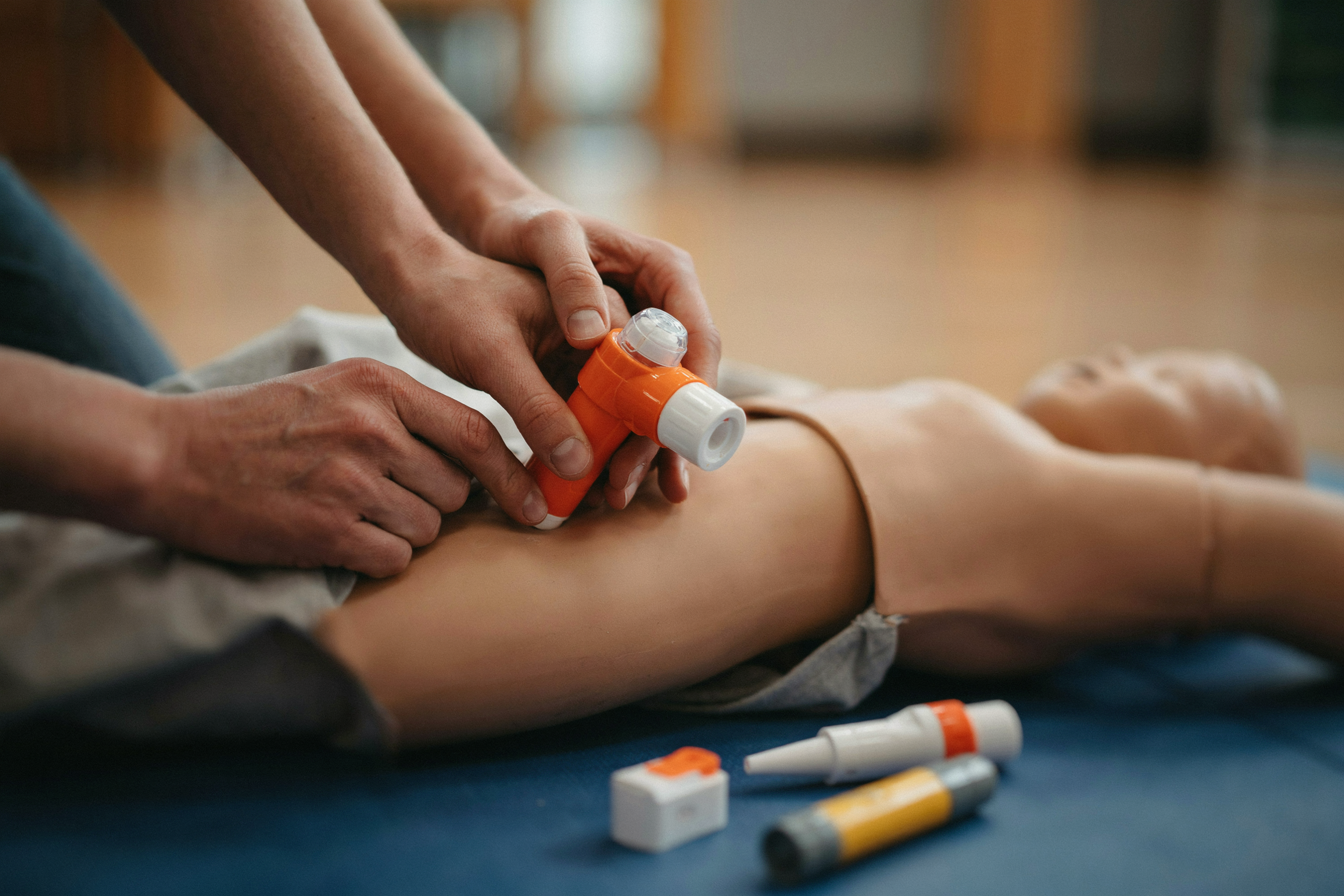
You practise with trainer devices, which have no needle and no adrenaline, so you can have a go as many times as you need without worrying about hurting anyone.
The point is practising on the devices families actually bring in, not just one brand. Where sessions include it, that also means a demonstration of neffy, the nasal spray.
Asthma First Aid and Using a Puffer With a Spacer
Asthma action plans don't come from ASCIA, they come from the National Asthma Council Australia. So the asthma side of your training follows their asthma first aid steps, including how to use a puffer with a spacer properly.
Managing Risk on Excursions, at Afternoon Tea and in Storage
The emergency is only part of it. Training also covers the everyday stuff that stops one happening:
Medication travelling with the child, every time they leave the room or the grounds
What goes in your excursion kits
Cooking activities and allergens
Regular expiry checks on devices and relievers
Storm season and high pollen periods are worth planning around too. Those are the afternoons when more kids reach for their reliever at once.
Skills are only half of it though. Services have specific requirements to meet.
Asthma and Anaphylaxis Requirements for Education and Care Services
So, do OSHC educators need asthma and anaphylaxis training? Short answer, yes.
Regulation 136: Who Must Be Trained
Under Regulation 136 of the Education and Care Services National Regulations, at least one educator, staff member or nominated supervisor has to be present and immediately available at all times who holds current approved:
First aid training
Anaphylaxis management training
Emergency asthma management training
"At all times" is the bit that catches people out. ACECQA's guidance extends this to excursions and transport too, so that a trained person needs to be on the bus and at the pool, not back at the hall.
There's also a variation for services on school premises, which matters if your OSHC runs on a school site. Check the current wording with your regulatory authority.
Requirement | Regulation | What satisfies it |
First aid | 136 | ACECQA-approved first aid qualification |
CPR | 136 | Approved CPR training |
Anaphylaxis management | 136 | ACECQA-approved anaphylaxis training |
Emergency asthma management | 136 | ACECQA-approved asthma training |
Medical Conditions Policies and Emergency Medication
Two more regulations sit alongside 136:
Regulation 90 requires a medical conditions policy, plus risk minimisation and communication plans
Regulation 94 allows medication to be given in an anaphylaxis or asthma emergency without prior authorisation
Nobody on your team should hold off on the device because they can't reach a parent.
Why HLTAID012 Alone May Not Cover It
Many services assume HLTAID012 covers it all, but first aid and anaphylaxis/asthma training are separate requirements under Regulation 136. If you're looking at a combined course, check it against the ACECQA approved list before you book.
Need to top up the first aid side as well? You can add HLTAID012 or CPR at the same time.
There's more than one way to meet these requirements though, and the cheapest option isn't always the most complete one.

ASCIA Free E-Training vs an Accredited Course: Which Does Your Team Need?
There's a free option and an accredited one, and they're not the same thing. It's also different again from the difference between HLTAID012 and an asthma and anaphylaxis course, covered above.
What ASCIA's Free E-Training Gives You
ASCIA runs free online e-training for education and care services, covering anaphylaxis only.
Its ACECQA approval was listed to the end of September 2026, so check its status before relying on it. ASCIA itself recommends pairing the e-training with regular practice on trainer devices.
What an Accredited Asthma and Anaphylaxis Course Adds
An accredited course, whether face-to-face or a blended asthma and anaphylaxis course, gives you a nationally recognised statement of attainment, asthma and anaphylaxis covered together, and assessed hands-on practice.
ASCIA free e-training | Accredited course | |
Covers asthma | No | Yes |
Device practice | Not included, ASCIA recommends adding it | Hands-on, with trainer devices |
Assessed | No hands-on assessment | Yes, assessed hands-on |
ACECQA-approved | Check current status | Check the ACECQA approved list |
Certificate | Not a statement of attainment | Nationally recognised statement of attainment |
The Honest Answer for OSHC and Childcare
Both have a place. The free e-training makes a good refresher, or a stopgap for a new casual while you're waiting for their next session.
But if you want to know your team can actually do it, not just that they've clicked through it, an accredited course gets you assessed competence. And it covers asthma as well, which the e-training doesn't.
Picking the right training is the easy part though. Getting the whole team there is the hard bit.
Getting a Casual-Heavy Team Trained Without the Chase
The problem isn't finding a course. It's getting a uni student to turn up on their day off.
Blended Learning That Works on a Phone
Blended learning splits the course in two. The theory gets done online, on a phone, on the bus to uni if that's what works. Then it's a practical session in person.
Onsite Sessions on Pupil-Free Days
This is where onsite asthma and anaphylaxis training really earns its keep. Instead of sending people out one at a time, the trainer comes to you:
Weekdays, when the service is empty
School holidays
Pupil-free days, so the whole team's there at once
A Weekly Plan Check
Training sticks better when you keep using it. Once a week, have the educator on shift read each at-risk child's plan out loud, then go and physically find that child's device. Simple, but it's the closest thing to practice between courses.
Keeping a Training Register You Can Hand an Assessor
When an assessor asks, hand something over instead of hunting through emails. Keep it simple: one row per educator, with separate expiry columns for first aid, anaphylaxis and asthma. Because they run on different cycles, you'll see the gaps coming well before they're a problem.
Make Every Shift a Trained Shift
Think back to that folder by the kitchen bench. The red plans in it aren't going anywhere, and neither are the kids they belong to.
What changes is who's standing next to them when something goes wrong. And you don't get to pick that afternoon.
That's really the whole point of ASCIA Action Plan training. The plan already tells you what to do. Training is what makes sure the person holding it can do it, calmly and in the right order.
When it's done right, it looks almost boring. The nearest educator reaches for the plan, the device and the phone without even looking around for you first.
The first step is the easy one. Pull out your register and check it against the three Regulation 136 requirements, first aid, anaphylaxis and asthma. Then check every shift is covered, excursions included.
Next, sort the new casuals. Don't wait for them to settle in, get them into the next public session while it's fresh.
Then think about your next pupil-free day. Getting a quote for onsite training means the whole team gets trained together, in your own hall, in one go. No chasing people for weeks.
Do those three things and every shift becomes a trained shift. Confident educators, settled families, and one less thing keeping you up at night.