Airway Management Training: Skills Every Responder Needs
You're first on scene. The patient isn't breathing. You've done CPR before, but is that actually enough when the airway is compromised and oxygen is needed right now?
For a lot of responders, the honest answer is no. Standard CPR training gets you a long way, but there's a point where the clinical reality of a real emergency outpaces what HLTAID011 or HLTAID009 prepares you for. An elderly resident with a partial obstruction. A post-cardiac arrest patient who needs high-flow oxygen before paramedics arrive. Two rescuers on a worksite who need to coordinate and neither of them has been trained in a two-rescuer protocol.
That's the gap that airway management training fills.
HLTAID015 Provide Advanced Resuscitation and Oxygen Therapy is the nationally accredited qualification that takes responders beyond basic CPR into the advanced airway, ventilation, and oxygen delivery skills that Australian Resuscitation Council (ARC/ANZCOR) guidelines are built around.
Whether you're renewing for AHPRA CPD requirements, meeting aged care compliance obligations, or upgrading your workplace first aid officers, this article covers what airway management training involves, which HLTAID015 skills you'll learn, who needs it, and how to find accredited training in Brisbane.
What Is Airway Management Training?
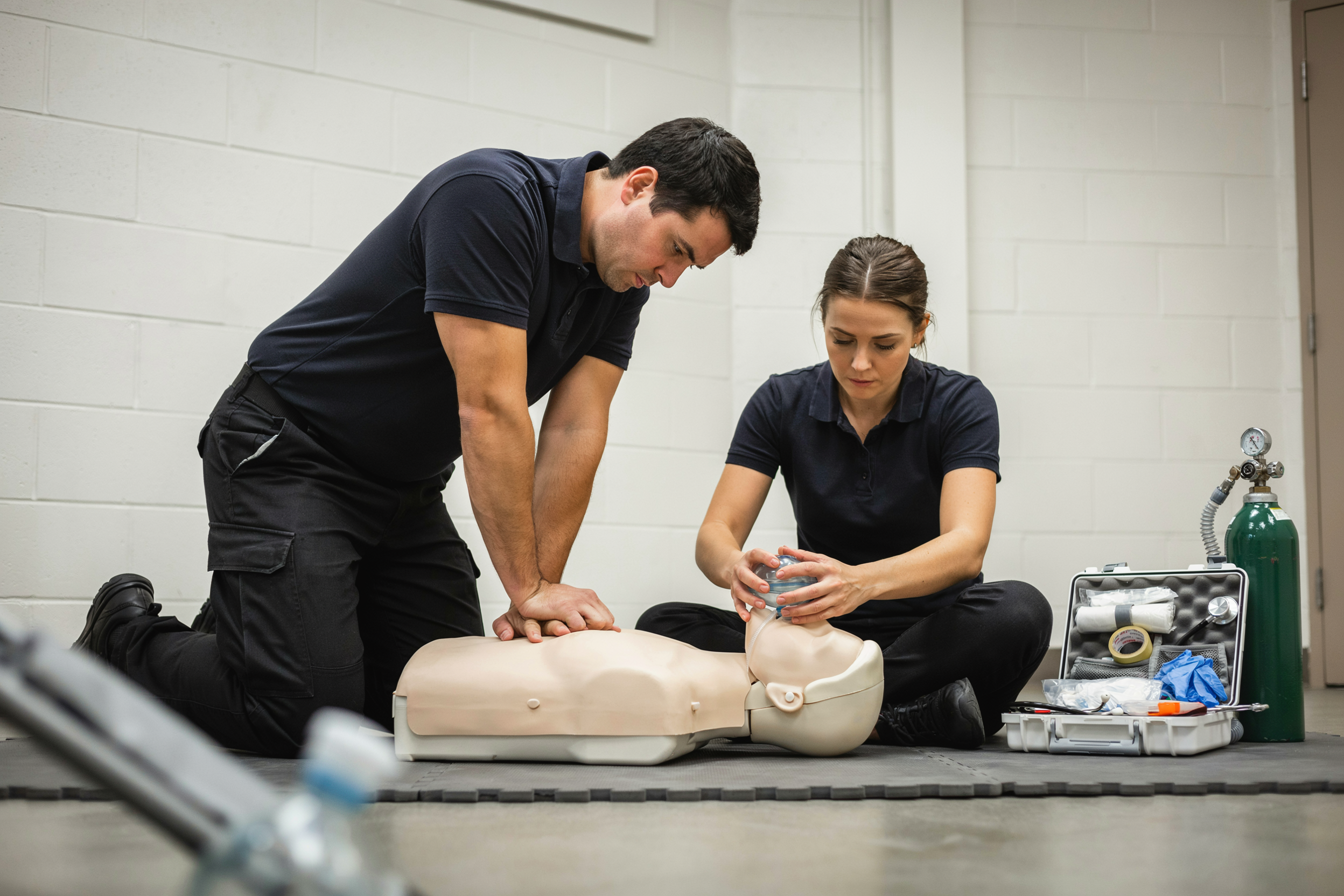
Airway management training teaches responders how to assess, open, and maintain a patient's airway during a cardiac or respiratory emergency. In Australia, these skills are formally covered under HLTAID015 Provide Advanced Resuscitation and Oxygen Therapy a nationally accredited qualification aligned with Australian Resuscitation Council (ARC/ANZCOR) guidelines.
Core skills taught include:
Head-tilt chin-lift and jaw-thrust techniques
Oropharyngeal airway (OPA) insertion and use
Bag-valve-mask (BVM) ventilation
Supplemental oxygen delivery and flow rate management
Recognizing and responding to airway obstruction
Two-rescuer resuscitation technique
Documentation and handover to paramedics
All content is delivered in alignment with current ARC/ANZCOR guidelines.
Why Airway Management Is the Significant Gap in Standard First Aid Training
Most people who've completed HLTAID011 or HLTAID009 walked away feeling capable, and they should. Those qualifications build real, practical skills. But there's a capability ceiling, and it becomes very obvious very quickly in environments where patients are elderly, medically complex, or where the risk of a serious cardiac or respiratory event is genuinely elevated.
This isn't a criticism of standard first aid training. HLTAID011 was designed for a broad population of responders across a broad range of workplaces. It does exactly what it's supposed to do. The issue is that some environments clinical, aged care, high-risk worksites demand more than that baseline covers.
What Standard CPR Training Leaves Out
There are four specific skills that HLTAID011 doesn't include, and they're not minor omissions. They're the exact skills that separate a responder who can maintain an airway from one who can't:
OPA insertion oropharyngeal airways are not covered in HLTAID011
BVM ventilation bag-valve-mask technique is not included
Oxygen delivery equipment supplemental oxygen, cylinders, flow rates, not in scope
Two-rescuer resuscitation coordinated protocol for multiple responders is not taught
The Scenarios Where Airway Management Skills Change the Outcome
The gap between these two cert levels isn't academic. It shows up in real scenarios where the outcome depends on whether the first responder has the right tools and the training to use them.
In an aged care setting, a resident with a partial airway obstruction may need an OPA to keep the airway patent until paramedics arrive. A responder with HLTAID011 has no training in OPA use, so they're limited to repositioning and rescue breathing, which may not be enough.
In a post-cardiac arrest situation where the patient has returned to shallow, inadequate spontaneous breathing, supplemental oxygen through a non-rebreather mask can make a significant difference to outcome. A responder trained to HLTAID015 can apply for it immediately. A responder with HLTAID011 cannot have the equipment there, but the training to use it safely isn't.
On a worksite where two trained responders are present, a coordinated two-rescuer resuscitation protocol is measurably more effective than a single rescuer working alone. HLTAID015 teaches that protocol explicitly role allocation, compression rotation, handover communication. HLTAID011 doesn't.
Knowing exactly which skills fill that gap is what HLTAID015 is built around.
Core Airway Management Skills Taught in HLTAID015
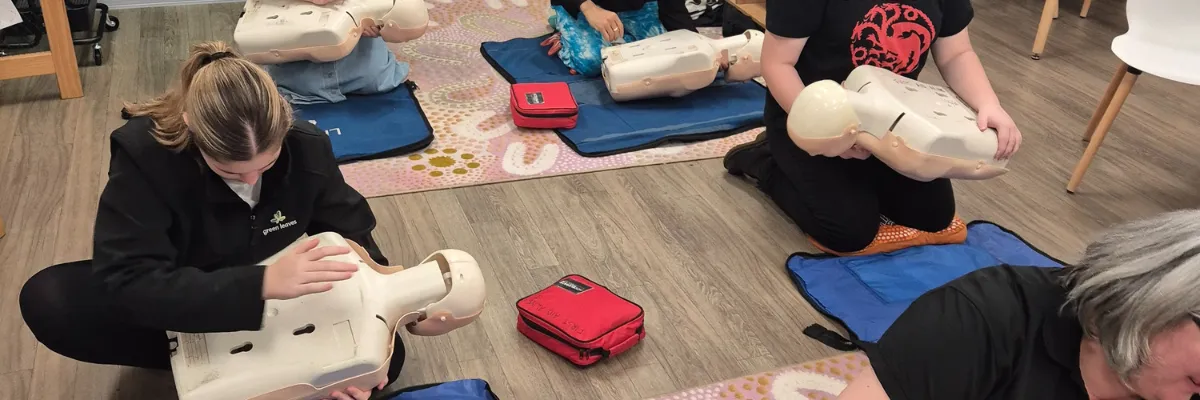
HLTAID015 is a hands-on, competency-based qualification. There's no written exam. Assessment is done by direct observation a trainer watches you perform each skill and signs off when you're competent. That means the course is built around doing, not reading about doing.
What follows is a plain-English breakdown of each skill area covered in Australian Resuscitation Council (ARC/ANZCOR) guidelines-aligned airway management training.
Airway Assessment and Positioning
Before any intervention happens, a responder needs to accurately assess what they're dealing with. HLTAID015 teaches the look-listen-feel assessment sequence looking for chest movement, listening for breath sounds, feeling for airflow to determine whether the airway is open, partially obstructed, or fully obstructed.
From there, the appropriate opening technique depends on the clinical picture. Head-tilt chin-lift is the standard method for a non-trauma patient. Where spinal injury is suspected of a fall, a vehicle incident, any mechanism that raises the possibility of jaw-thrust is used instead, because it opens the airway without moving the cervical spine. For an unconscious patient who is breathing adequately, the recovery position protects the airway and reduces the risk of aspiration while the responder waits for paramedics.
Oropharyngeal Airway (OPA) Insertion
An OPA is a curved plastic device that sits in the mouth and holds the tongue forward, keeping the airway open in an unconscious patient who has lost muscle tone. It's one of the most practically useful pieces of equipment in advanced resuscitation, and one that HLTAID011 doesn't cover at all.
Sizing is done by measuring from the center of the mouth to the earlobe. HLTAID015 teaches sizing, the rotational insertion technique, and when not to use it. An OPA is contraindicated in a conscious or semi-conscious patient because it triggers the gag reflex and can cause vomiting and aspiration.
Bag-Valve-Mask (BVM) Ventilation
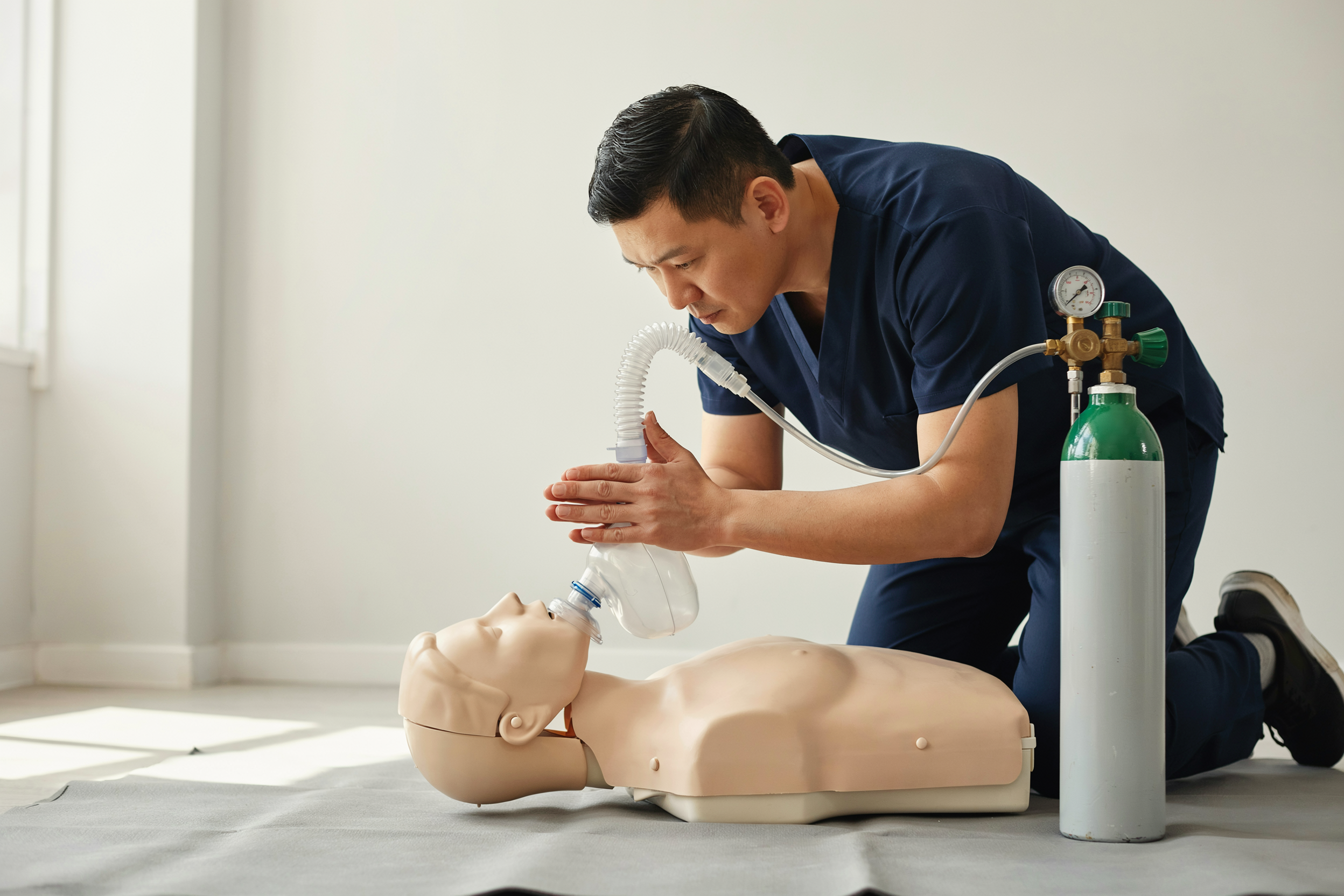
A BVM is a self-inflating bag connected to a mask and, when available, an oxygen supply. It delivers controlled ventilation to a patient who isn't breathing adequately, and it's significantly more effective than mouth-to-mouth rescue breathing when used correctly.
The EC-grip is the standard technique for mask seal three fingers under the jaw (the E) and two fingers pinching the mask to the face (the C). A good mask seal is the difference between effective ventilation and air going everywhere except the lungs. Tidal volume is judged visually to squeeze the bag enough to see the chest rise, and no more. Over-ventilation forces air into the stomach, increases aspiration risk, and reduces venous return. The ARC guideline reference for when an advanced airway is in place is 10 breaths per minute, a rate that's slower than most untrained responders instinctively attempt.
HLTAID015 covers both one-rescuer BVM technique and the more effective two-rescuer approach, where one person maintains the mask seal with both hands while the other squeezes the bag.
Supplemental Oxygen Delivery
Oxygen delivery isn't one-size-fits-all. The device used depends on the patient's condition and the concentration of oxygen needed.
Hudson mask used for a spontaneously breathing patient who needs supplemental support
Non-rebreather mask the standard choice for high-flow pre-hospital oxygen in a seriously unwell patient
BVM with oxygen circuit used when the patient is not breathing adequately
HLTAID015 also covers cylinder operation and safety, how to check a cylinder, open the valve correctly, read the gauge, and manage the equipment safely during a resuscitation.
Advanced Two-Rescuer Resuscitation
When two trained responders are present, a coordinated two-rescuer protocol is both more sustainable and more effective than one person doing everything. HLTAID015 teaches clear role allocation from the start, one rescuer as compressor, one as ventilator. The compression-to-ventilation ratio stays at 30:2 until an advanced airway is secured, at which point compressions become continuous and ventilation shifts to asynchronous at 10 breaths per minute, per ARC guidelines.
Compressor rotation happens regularly to maintain compression quality fatigue degrades technique faster than most people expect. HLTAID015 trains the communication protocol for that handover so it happens cleanly without interrupting the resuscitation.
The answer to who needs them depends on your role and the regulatory environment you work in.
Who Needs Airway Management Training and Why
HLTAID015 isn't a general recommendation. For the people who need it, there's usually a regulatory driver, an employer mandate, or a contract specification sitting behind the decision. Here's how that breaks down by role.
Healthcare Professionals Nurses, Paramedics, Allied Health
For registered nurses, enrolled nurses, midwives, paramedics, and allied health professionals, HLTAID015 sits at the intersection of professional obligation and genuine clinical relevance.
The AHPRA CPD requirements are specific. Registered nurses need 20 CPD hours per year, enrolled nurses 30, midwives 35. HLTAID015, as a nationally accredited qualification, contributes to that requirement without ambiguity about eligibility.
Beyond the CPD cycle, employer mandates are tightening. ICU, ED, and cardiac care units at major Brisbane hospitals are increasingly specifying HLTAID015 over HLTAID011 for nursing staff. The ARC also recommends an annual resuscitation update for clinical staff, which means this isn't a set-and-forget cert even at the three-year renewal mark.
The practical barrier for this segment is scheduling, not motivation. Rotating shift workers can't reliably commit to a weekday course. Weekend and evening availability isn't a preference; it's the primary filter when a nurse is deciding whether to book. A provider whose entire schedule runs Monday to Friday loses this segment entirely.
Aged Care and NDIS Support Workers
For aged care and NDIS support workers, HLTAID015 is driven by two things that sit alongside each other compliance requirements and genuine personal concern about being capable when it counts.
The Aged Care Quality Standards require current first aid and resuscitation training. Facilities are audited by the Aged Care Quality and Safety Commission, and training records are reviewed as part of that process. An expired or incorrect cert is an audit finding, and that pressure flows directly to support workers.
The NDIS Practice Standards carry a similar expectation. NDIS Commission audits review training records, and first aid and resuscitation competency is a core part of what they check.
Beyond compliance, aged care and disability support workers spend their shifts with people at genuine risk. The thought of being on shift when something goes wrong and not knowing what to do beyond basic CPR is a real source of anxiety. HLTAID015 isn't just a cert to satisfy an auditor. It's the training that makes a support worker feel like they can actually hold the situation together until paramedics arrive.
Workplace First Aid Officers in High-Risk Industries
For WHS managers, safety officers, and operations directors in high-risk industries, HLTAID015 is a risk management decision, not a discretionary upgrade from HLTAID011.
The WHS Act 2011 (QLD) places a duty of care on PCBUs to provide first aid appropriate to the risk profile of the workplace. In industries like mining services, utilities, emergency response contracting, oil and gas, large-scale construction, government agencies, and major logistics where the risk of a serious cardiac, trauma, or respiratory event is real and the response window before paramedics arrive can be significant the standard HLTAID011 capability ceiling is a genuine liability exposure.
Contract specifications are also shifting. Queensland government contracts and resource sector project agreements are increasingly requiring evidence that designated first aid officers hold HLTAID015, not just HLTAID011. A workplace fatality where investigation reveals a lapsed or insufficient certification creates personal and organizational legal exposure that's very hard to defend, and HLTAID015 is part of how a responsible safety program protects against that.
How to Choose an Airway Management Training Provider
Not all advanced resuscitation training is equal. The certificate might look the same, but the quality of what sits behind it the trainer's clinical knowledge, the equipment used, the documentation issued varies more than most people realize. Here's what to actually check before you book.
The first thing to verify is RTO registration. Any provider delivering HLTAID015 must be a registered training organisation with ASQA, and HLTAID015 must appear on their scope of registration specifically it's a separate unit from HLTAID011 and doesn't automatically follow from it. You can verify RTO registration at training.gov.au. If a provider can't give you their RTO number, that's the end of the conversation.
ARC/ANZCOR guideline alignment is the clinical credibility check. For nurses, paramedics, and allied health professionals, this is non-negotiable. If you ask a provider whether their course content is aligned with current ARC/ANZCOR guidelines and they can't answer that question clearly and confidently, they've disqualified themselves. Outdated protocols aren't just academically wrong, they're professionally problematic for healthcare workers who are expected to train to current standards.
Weekend and evening availability is the difference between accessible training and training that can't actually be booked by the people who need it most. For WHS managers, group and onsite delivery options aren't a nice-to-have. Pulling first aid officers off the floor to travel to a venue creates disruption that a good provider removes entirely.