Advanced Resuscitation Techniques: The 2026 Complete Guide
When a patient stops breathing and you're first on scene, do you have the skills and the current certification to buy them time until the ambulance arrives?
If you're a registered nurse, enrolled nurse, paramedic, allied health professional, aged care or NDIS worker, or a designated workplace first aid officer in Brisbane or South East Queensland, that's not a hypothetical question. It's the reality of your role.
Standard CPR training gets a lot of people through a competency check. But the gap between HLTAID011 and what's actually required in high-acuity, high-risk, or regulated environments is significant. Advanced resuscitation techniques covered under HLTAID015 and aligned to current Australian Resuscitation Council (ARC) guidelines go well beyond basic compressions and an AED.
This guide covers the core advanced resuscitation techniques you need to know in 2026, from oxygen therapy and advanced airway management to what's changed in ARC guidelines, and how to get certified through a nationally accredited Brisbane RTO.
In healthcare, aged care, and high-risk workplaces, the currency of training matters. An expired or insufficient cert isn't just an administrative problem. It creates real personal and regulatory risk.
What Are Advanced Resuscitation Techniques?
Advanced resuscitation techniques are the skills and procedures used to sustain life during a cardiac or respiratory emergency that go beyond basic CPR. They include oxygen therapy, advanced airway management, and the use of automated external defibrillators (AEDs), performed in accordance with current Australian Resuscitation Council (ARC) guidelines.
The core techniques covered under this category include:
Cardiopulmonary resuscitation (CPR) to current ARC compression-to-ventilation ratios
Bag-valve-mask (BVM) ventilation
Supplemental oxygen therapy administration
Oropharyngeal airway (OPA) insertion and management
Nasopharyngeal airway (NPA) insertion and management
Automated external defibrillator (AED) operation
Two-rescuer CPR coordination
Recognition and management of foreign body airway obstruction (FBAO)
In Australia, these skills are formally assessed and certified under the nationally accredited unit HLTAID015 Provide Advanced Resuscitation and Oxygen Therapy.
To understand why these techniques matter, it helps to see exactly where they sit above standard CPR training.
How Advanced Resuscitation Differs From Standard CPR
If you've already got your HLTAID011 or HLTAID009, you're not starting from zero. That training gave you a real foundation compressions, AED operation, airway checks. For a lot of workplaces and roles, it's the right level.
But there's a point where basic CPR hits its ceiling. When the patient isn't responding the way you'd expect, when airway management becomes more complex, when oxygen is available and needs to be delivered properly, or when you're working alongside another rescuer and coordination matters, that's where HLTAID011 runs out of road.
HLTAID015 picks up exactly where standard training stops. It adds the clinical tools that change outcomes in prolonged or complex resuscitation events: supplemental oxygen therapy, advanced airway adjuncts like OPA and NPA, bag-valve-mask ventilation, and structured two-rescuer technique. These aren't extras. In high-acuity environments like ED, ICU, aged care, and high-risk industry, they're the difference between managing a situation and just waiting for paramedics.
Here's how the three certification levels compare:
The jump from HLTAID011 to HLTAID015 isn't cosmetic. Oxygen therapy and advanced airway management are genuinely different skill sets, ones that require hands-on practice, proper assessment, and a trainer who can actually evaluate technique, not just tick attendance.
Knowing what the techniques are is one thing. Knowing you're practicing them to current ARC standards is another.
ARC Guidelines 2026 What Healthcare and Care Workers Need to Know
The Australian Resuscitation Council is the peak body that sets resuscitation standards in Australia. If you're AHPRA-registered or working in aged care or high-risk industry, ARC guidelines published through the ANZCOR (Australian and New Zealand Committee on Resuscitation) guideline series are the standard your training is measured against. Not the trainer's preference. Not a provider's internal protocol. The ANZCOR guidelines.
For anyone training to HLTAID015, the most operationally relevant is ANZCOR Guideline 7 Cardiopulmonary Resuscitation.
The current 2026 protocol points every HLTAID015 candidate needs to know:
Compression rate: 100–120 per minute not faster, not slower. Rate outside this range measurably reduces cardiac output.
Compression depth: At least 5cm in adults with full chest recoil between compressions. Incomplete recoil impedes venous return.
Compression-to-ventilation ratio: 30:2 for a single rescuer. Once an advanced airway is in place, continuous compressions with asynchronous ventilation no pausing for breaths.
Early defibrillation: Every minute without defibrillation in a shockable rhythm reduces survival probability. AED deployment is not secondary to airway management; it runs in parallel.
High-flow oxygen: In cardiac arrest, oxygen is delivered via BVM or non-rebreather mask not via nasal cannula. Flow rate and reservoir bag use matter and are assessed in HLTAID015.
"Survival rates from out-of-hospital cardiac arrest drop by approximately 10% for every minute without effective resuscitation." Australian Resuscitation Council
Why Guideline Currency Matters for AHPRA-Registered Professionals
AHPRA's Nursing and Midwifery Board requires registered nurses to complete 20 CPD hours per year. Resuscitation training contributes to that requirement, but only when it's nationally accredited and properly documented. Training to outdated protocols creates both a clinical risk and a compliance gap. Nationally accredited HLTAID015 training, delivered to current ANZCOR standards, satisfies both.
So who is actually required to hold this level of certification in 2026?
Who Needs Advanced Resuscitation Training in 2026?
HLTAID015 isn't a universal requirement but for three distinct groups in Brisbane and South East Queensland, it's either mandated, strongly expected, or increasingly specified by regulators and contracts.
Healthcare Professionals Nurses, Paramedics, Allied Health
For AHPRA-registered professionals working in high-acuity settings, HLTAID015 is frequently an employer mandate rather than a personal choice. Nursing staff in ICU, ED, cardiac care, and high-dependency units are increasingly required to hold HLTAID015 not just HLTAID011.
The ARC recommends annual CPR updates for healthcare workers. HLTAID015 satisfies both the annual resuscitation currency requirement and the 3-yearly certification renewal meaning it does more compliance work per booking than a standard CPR refresher. And because it's nationally accredited, it contributes directly to your documented AHPRA CPD hours, something a non-accredited in-service training session won't do.
Aged Care and NDIS Workers
The Aged Care Quality Standards require all direct care staff to maintain current resuscitation training. The Aged Care Quality & Safety Commission actively reviews training records during audits, and expired or insufficient certificates are a formal finding under the Aged Care Act 1997. If your facility has an audit pending and a gap in training records, that's a problem with a hard deadline.
For NDIS registered providers, the NDIS Practice Standards require that workers hold the training competencies relevant to the participants they support. For support workers with participants who have complex health needs or elevated cardiac risk, HLTAID015 is the appropriate level HLTAID011 alone may not satisfy the spirit of the standard.
Workplace First Aid Officers in High-Risk Industries
Under the WHS Act 2011 (QLD), employers have a duty of care to ensure designated first aid officers hold training appropriate to the risk environment. In industries like mining services, utilities, emergency response contractors, oil and gas, and large-scale construction, HLTAID015 is increasingly the specified standard for designated first aid officers not an upgrade, a requirement. A growing number of Queensland government contracts and major resource sector project specifications now name HLTAID015 explicitly. If HLTAID015 is listed in a tender document or client onboarding checklist, HLTAID011 won't satisfy it.
An insufficient certification on a post-incident review isn't just a regulatory problem. It's a personal liability issue.
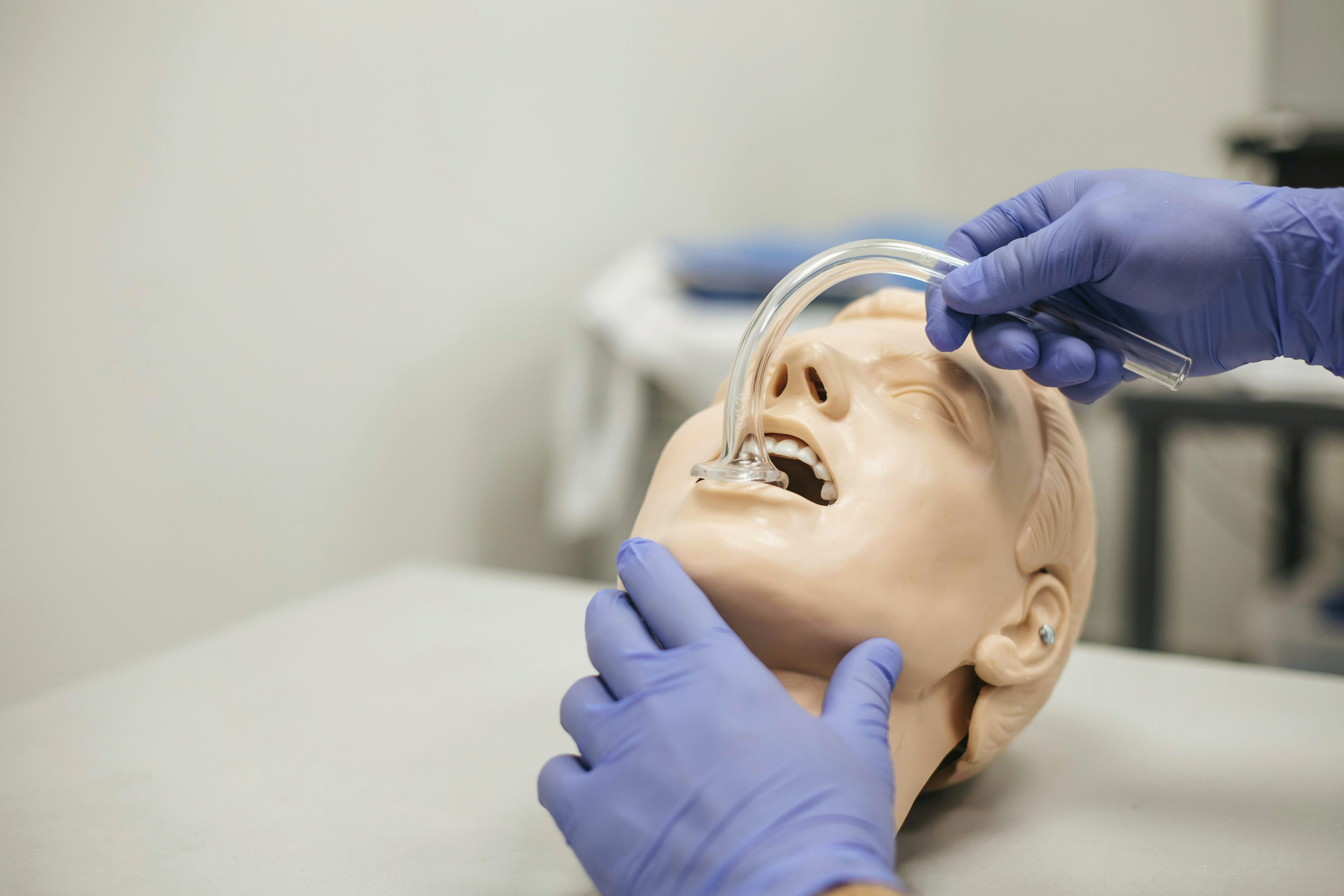
Core Advanced Resuscitation Techniques Covered in HLTAID015
Cardiopulmonary Resuscitation (CPR) to ARC Standards
CPR in HLTAID015 is assessed against current ANZCOR Guideline 7 compression rate, depth, hand placement, and recoil are all evaluated, not just observed. The specifics: 100–120 compressions per minute, at least 5cm depth in adults, with full chest recoil between each compression. Hand placement is heel of the dominant hand on the lower half of the sternum not on the xiphoid process.
Rescuer fatigue becomes a clinical problem in prolonged events. HLTAID015 addresses this through structured two-rescuer rotation that maintains compression quality without interrupting the rhythm of the response. Both single-rescuer and two-rescuer techniques are assessed in practical scenarios.
Advanced Airway Management OPA and NPA
The oropharyngeal airway (Guedel) is the standard first-line adjunct for an unconscious patient with no gag reflex. Sizing is by measurement from the center of the mouth to the angle of the jaw. Insertion in adults is rotational: insert inverted, rotate 180 degrees as it passes the soft palate. The contraindication most commonly missed: any intact gag reflex. An OPA in a patient who still has a gag reflex causes active harm.
The nasopharyngeal airway is preferred when an OPA is contraindicated facial trauma, partial consciousness, intact gag reflex. Lubrication before insertion isn't optional. Both adjuncts are assessed with manikins and simulated clinical scenarios. You'll be expected to select the right device for the right presentation not just insert what's handed to you.
Bag-Valve-Mask (BVM) Ventilation
BVM ventilation is one of the highest-skill, highest-failure-rate components of advanced resuscitation and one of the clearest differentiators between HLTAID015 and everything below it.
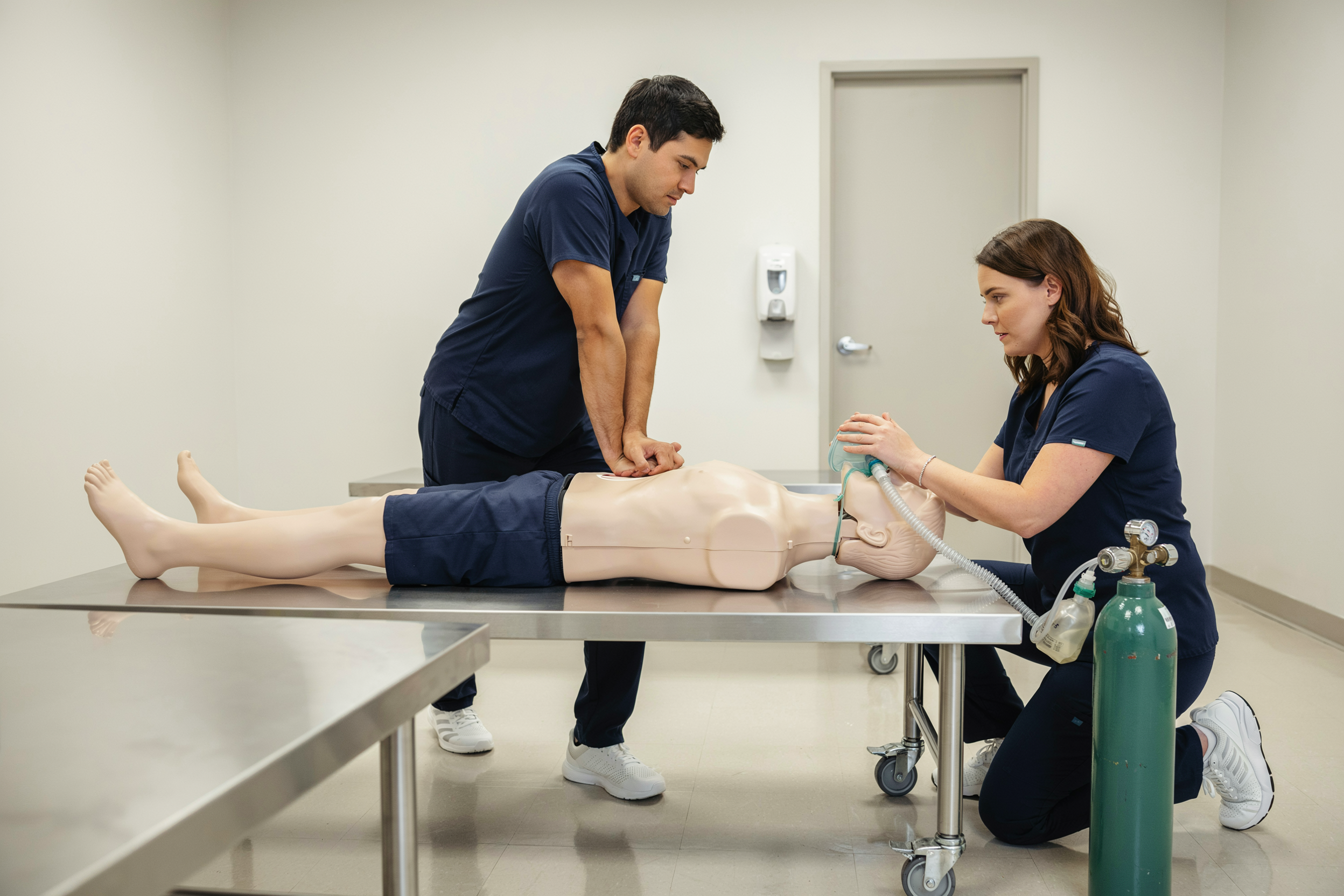
Single-operator technique requires one hand maintaining a C-E mask seal while the other squeezes the bag. Mask seal is the primary failure point a leak means the tidal volume you're delivering isn't going where you think it is. Tidal volume target is 500–600ml in adults.
Two-operator technique addresses the seal problem: one rescuer dedicates both hands to mask hold, the second manages the bag. BVM with reservoir bag connected to high-flow oxygen delivers close to 100% FiO2. Without the reservoir bag attached and the flow rate set correctly, you're delivering room air not oxygen therapy.
Supplemental Oxygen Therapy
Oxygen therapy is the component that makes HLTAID015 genuinely distinct from HLTAID011 and HLTAID009. Neither of those certifications covers it.
In a cardiac arrest context, high-flow oxygen is delivered via BVM with a reservoir, or via non-rebreather mask for a patient who is breathing but deteriorating. Oxygen cylinder operation is assessed: reading the gauge correctly, setting the flow rate, checking the regulator, and identifying when the cylinder is approaching empty. These are practical skills that matter in real emergencies.
AED Advanced Application and Multi-Rescuer Coordination
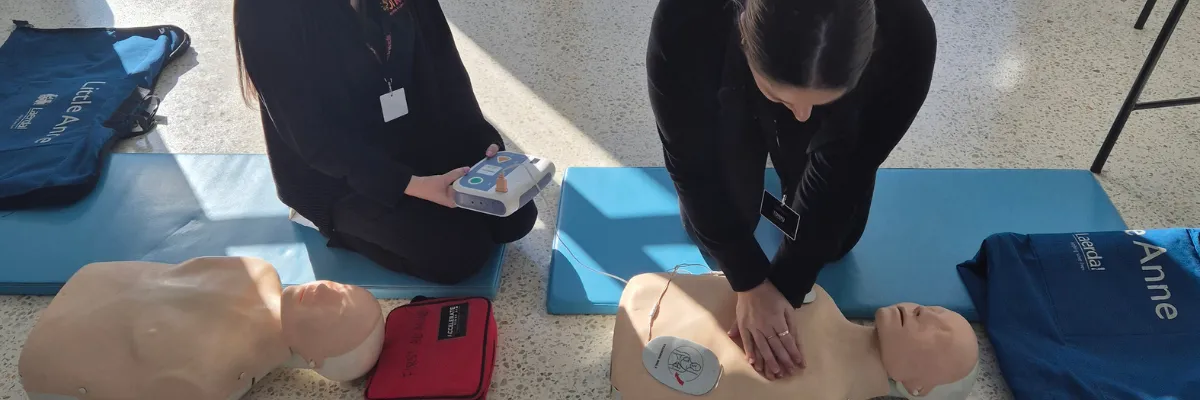
You already know how to operate an AED from HLTAID011. HLTAID015 takes it further specifically around multi-rescuer coordination and minimizing no-flow time. Compressions continue until the AED instructs a shock, pad placement happens without halting the resuscitation sequence where possible, and the rescuer managing the AED communicates clearly before anyone stands clear.
Special circumstances covered include: wet environment, pacemaker or ICD present, and pregnancy each with specific technique adjustments.
Recognizing and Managing Deterioration
The best resuscitation outcome is the one that starts before cardiac arrest. HLTAID015 includes recognition of pre-arrest signs of reduced consciousness, abnormal breathing, absent or weak pulse so the response begins at deterioration, not at collapse.
The structured response framework is DRSABCD: Danger, Response, Send for help, Airway, Breathing, CPR, Defibrillation. In HLTAID015 it's applied in the context of the full advanced skill set calling for backup, initiating two-rescuer CPR, deploying oxygen, managing airway adjuncts all within a coordinated scenario response.
WRAP UP
Advanced resuscitation techniques aren't a credential upgrade for the sake of it. They represent a genuine capability shift from knowing the basics of CPR to being able to manage a complex resuscitation event from first response through to handover. Oxygen therapy, advanced airway adjuncts, two-rescuer coordination, and BVM ventilation are skills that change what's possible in the critical minutes before paramedics arrive. That gap matters in real emergencies, and it matters in audit rooms.
For healthcare professionals, aged care workers, NDIS support staff, and workplace first aid officers in high-risk industries, the question isn't really whether to pursue HLTAID015. Regulatory bodies, employers, and contract specifications are increasingly making that decision for you. The more relevant question is whether your current certification actually reflects the standard your role demands and whether the provider who issued it trained you to current ANZCOR guidelines or to whatever was current three years ago.
Getting the right certification at the right level is only half the equation. The other half is making sure you got it from a provider whose training holds up under clinical scrutiny, under audit, and under the pressure of an actual emergency. A nationally accredited course delivered by trainers with real clinical backgrounds, aligned to current ARC guidelines, is a different product to a tick-box course that produces the same certificate on paper.
Resuscitation competency isn't a set-and-forget qualification. The ARC recommends annual CPR updates for a reason skill retention in low-frequency, high-stakes procedures degrades faster than most people realize. The professionals who perform best in real resuscitation events are the ones who train regularly, train to current guidelines, and train in realistic scenario-based environments that replicate the actual conditions of their role.
If you're reviewing your training currency, confirming what your employer or regulator requires, or coordinating certification for a team, the five-point checklist in this guide gives you a framework for evaluating any provider objectively. Accreditation, guideline currency, trainer qualifications, scheduling flexibility, and certificate turnaround aren't arbitrary criteria. They're the difference between training that serves you when it counts and training that looks right on paper until it's tested.