Advanced Resuscitation Skills: What Sets Them Apart
You've done the CPR course. You've ticked the compliance box. But when a patient deteriorates in front of you and the defibrillator is already attached, what happens next?
That's a question a lot of healthcare workers, aged care staff, and workplace first aid officers can't fully answer. Standard CPR training gives you a foundation. It teaches you to compress, to breathe, to use an AED. But it stops well short of what's actually needed when the situation gets complex, when a patient needs supplemental oxygen, when you're managing an airway with more than a pocket mask, or when you're coordinating a resuscitation team and the ambulance is still ten minutes out.
That's where advanced resuscitation skills come in.
This article breaks down exactly what advanced resuscitation skills involve, who needs them, and why HLTAID015 is the nationally recognized standard for healthcare, aged care, and high-risk workplace environments across Queensland. Whether you're a registered nurse trying to make sense of your AHPRA CPD obligations, an aged care worker who needs to know their cert still holds up, or a WHS manager reviewing your team's training level, this one's for you.
What Are Advanced Resuscitation Skills?
Advanced resuscitation skills are emergency response competencies that go beyond standard CPR. They equip trained responders to manage cardiac and respiratory emergencies from initial assessment through to advanced intervention, including oxygen therapy, advanced airway management, and resuscitation equipment operation. In Australia, these skills are formalized under HLTAID015 (Provide Advanced Resuscitation and Oxygen Therapy), a nationally accredited qualification required in healthcare, aged care, and high-risk workplace environments.
Core competencies include:
High-quality CPR to current ARC (Australian Resuscitation Council) guidelines
Advanced airway management techniques
Supplemental oxygen therapy delivery
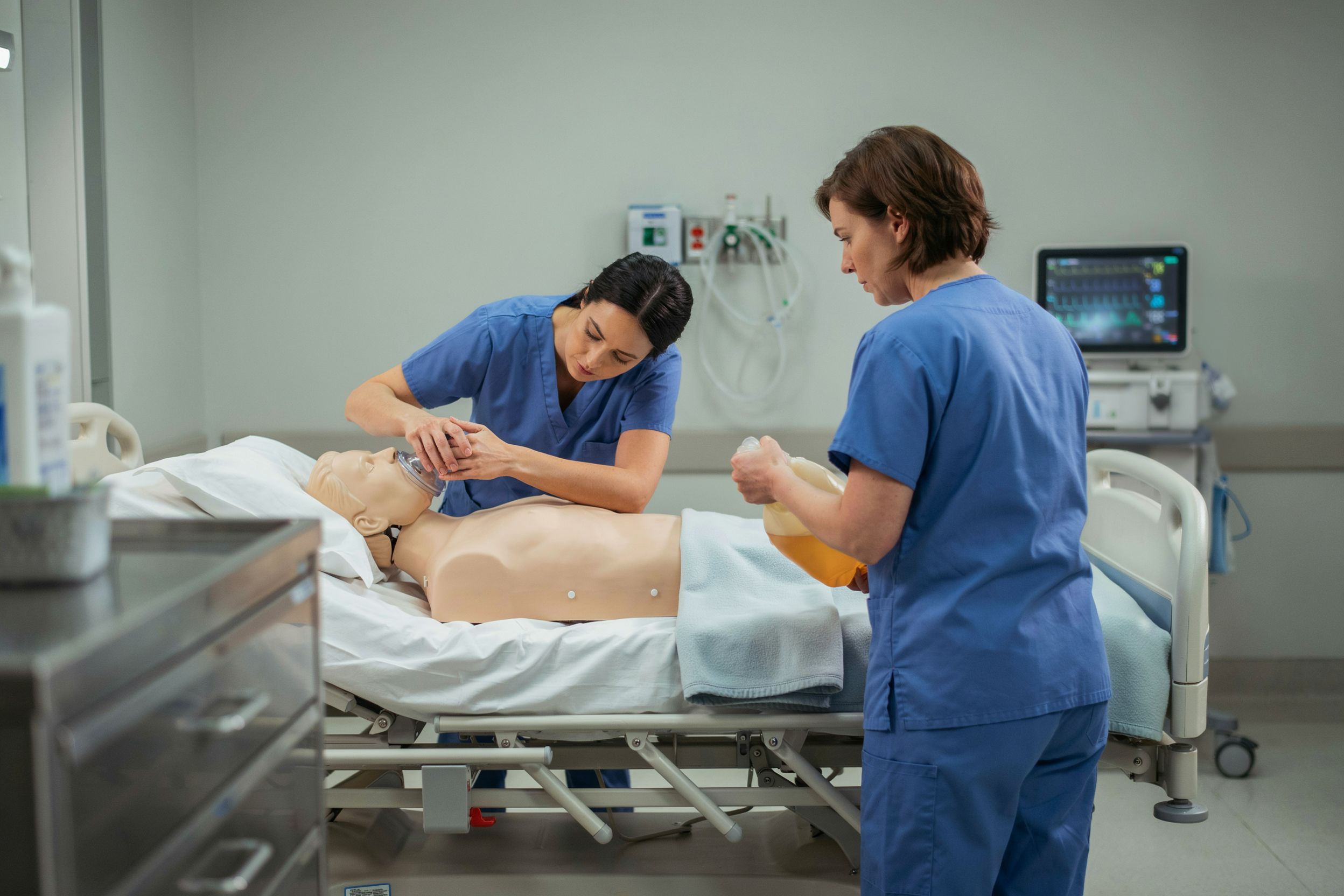
Bag-valve-mask (BVM) resuscitation equipment operation
Automated External Defibrillator (AED) operation
Single-responder and team resuscitation coordination
Recognition and management of deteriorating patients
How Advanced Resuscitation Skills Differ From Standard CPR
Most people in healthcare, aged care, or high-risk industries already have an HLTAID011 or HLTAID009 on file. For a lot of roles, that's been enough. But there's a meaningful gap between what standard CPR training covers and what HLTAID015 adds, and in a real resuscitation event, that gap matters.
HLTAID009 and HLTAID011 cover the essentials: compressions, basic airway management, rescue breathing, and AED use. They stop short of oxygen therapy, advanced airway adjuncts, and the team coordination that's expected when you're the most qualified person in the room waiting for QAS.
HLTAID015 picks up where standard training leaves off, adding supplemental oxygen delivery, oropharyngeal and nasopharyngeal airways, bag-valve-mask ventilation, and a resuscitation sequence built for team dynamics, not just solo response.
The Core Skills Covered in HLTAID015
High-Quality CPR to ARC Guidelines
HLTAID015 trains to current ANZCOR 2021 guidelines, meaning correct compression rate, appropriate depth, full chest recoil, and minimized interruptions to circulation. If your training isn't aligned to current Australian Resuscitation Council guidelines, you're not just behind on paperwork. You're behind on practice.
Advanced Airway Management
Trainees learn to insert and manage oropharyngeal airways (OPAs) and nasopharyngeal airways (NPAs), along with suction techniques, because vomit, blood, and secretions are a reality in real resuscitation events. HLTAID015 gives you the hands-on practice to use that equipment confidently, not just know it exists.
Oxygen Therapy Delivery
This is the clearest differentiator between HLTAID011 and HLTAID015. Trainees learn to deliver supplemental oxygen using non-rebreather masks, understand appropriate flow rates, and recognize when oxygen therapy is indicated. HLTAID011 doesn't cover oxygen therapy at all. If your role puts you near patients at elevated risk of respiratory or cardiac events, that's a meaningful gap.
Bag-Valve-Mask (BVM) Ventilation
A BVM delivers positive pressure ventilation to a patient who isn't breathing adequately. HLTAID015 covers both single-person and two-person technique. The two-person method produces significantly better mask seal and ventilation volume, exactly the kind of thing that matters when a patient is in full arrest and the team is working together.
AED Operation and Defibrillation Support
HLTAID015 extends AED training to the advanced responder's role in a full defibrillation sequence, including coordinating compression-to-shock transitions, minimizing hands-off time, and maintaining resuscitation quality throughout, not just knowing how to push the button.
Patient Assessment and Deterioration Recognition
What HLTAID015 adds beyond the DRSABCD framework is the ability to recognize pre-arrest warning signs before a patient reaches full arrest. Altered consciousness, labored breathing, falling oxygen saturation, skin color changes, picking these up early creates options. Preventing the arrest is always better than managing it.
Who Needs Advanced Resuscitation Skills in Queensland?
Healthcare Professionals Nurses, Paramedics, Allied Health
For registered nurses, enrolled nurses, paramedics, and allied health professionals, HLTAID015 sits at the intersection of employer expectation and professional registration obligation.
AHPRA registration renewal requires documented CPD hours each year. HLTAID015 is a nationally accredited qualification, meaning completion contributes directly to those AHPRA CPD requirements. Many hospital employers now specify HLTAID015 over HLTAID011 for ICU, ED, and cardiac care staff. The Australian Resuscitation Council also recommends an annual CPR refresher (HLTAID009) for clinical workers between full renewals.
Aged Care and NDIS Support Workers
The Aged Care Quality Standards require that aged care staff maintain current first aid and resuscitation training. Facilities are audited by the Aged Care Quality & Safety Commission, and a lapsed cert isn't just a personal compliance issue, it puts the employer at risk too.
For NDIS registered providers, the NDIS Practice Standards require workers hold the skills needed to support participants safely. The NDIS Commission reviews training records during audits.
Beyond compliance, elderly residents and NDIS participants are at elevated risk of cardiac and respiratory events. The environment is often under-resourced compared to a hospital, with fewer staff on shift and longer ambulance response times. Having a worker who can deliver oxygen, manage an airway, and operate a BVM is a genuine safety measure, not a luxury.
Workplace First Aid Officers in High-Risk Industries
The WHS Act 2011 (QLD) places obligations on PCBUs to provide appropriate first aid capability. In mining services, utilities, emergency response contracting, and large-scale construction, "appropriate" increasingly means HLTAID015 for designated first aid officers. A growing number of government contracts and major project supply agreements now specify HLTAID015 explicitly as a condition of engagement. For a WHS manager coordinating compliance ahead of a contract renewal, that's not a discretionary upgrade. It's a tender requirement.
Advanced Resuscitation Skills in Real Emergency Scenarios
Skill lists tell you what the training covers. Scenarios tell you whether it's actually going to help when something goes wrong in front of you.
Cardiac arrest on a hospital ward. A nurse is the most senior clinician on the floor when a monitored patient goes into ventricular fibrillation. The arrest team is two minutes away. With standard CPR training, compressions can start and the AED can be used. What's harder to do without HLTAID015 is insert an oropharyngeal airway, transition to BVM ventilation, and manage the oxygen delivery setup while compressions continue uninterrupted. With advanced skills, that sequence moves without hesitation. By the time the arrest team arrives, the airway is secured, oxygen is running, and compressions haven't stopped.
Respiratory emergency in aged care. One of two staff members on a night shift responds when an elderly resident with COPD becomes unresponsive. Ambulance ETA is twelve minutes. Twelve minutes is a long time when someone isn't breathing adequately. What HLTAID015 adds is the ability to reach for the facility's oxygen equipment and actually use it correctly, selecting the right mask, setting an appropriate flow rate, and delivering supplemental oxygen before the situation deteriorates further. If the resident's breathing becomes insufficient, BVM ventilation can maintain oxygenation until QAS arrives. That's not an unlikely scenario in aged care. It plays out regularly.
Workplace cardiac event on a construction site. A designated first aid officer responds to a colleague who's collapsed. QAS response is estimated at ten minutes. With HLTAID011, CPR and AED use are possible. With HLTAID015, the first aid officer can also manage the airway with adjuncts, deliver supplemental oxygen from the site's emergency kit, and coordinate a second responder into an effective two-person resuscitation sequence, maintaining higher quality CPR for longer. A workplace fatality where a post-incident review finds the first aid officer was undertrained is a catastrophic outcome, professionally, legally, and personally. Advanced resuscitation skills are a defensible, documented response to a foreseeable risk.
How HLTAID015 Aligns With ARC Guidelines
The authoritative body for resuscitation guidelines in Australia is the Australian Resuscitation Council. The ARC publishes and maintains the ANZCOR guidelines (Australian and New Zealand Committee on Resuscitation), which set the evidence-based standard for how resuscitation is taught and practiced across the country.
The 2021 ANZCOR guideline updates introduced meaningful changes, including adjustments to compression parameters, updated guidance on oxygen use during CPR, and refinements to team-based resuscitation sequencing. These changes reflected accumulated clinical evidence, and they changed what best-practice resuscitation looks like in a hospital, aged care facility, or worksite.
HLTAID015 is structured to reflect those current guidelines. A trainer who teaches outdated protocols, or who can't answer a question about what changed in 2021, is a red flag worth acting on.

HLTAID015 Certification - What to Expect
HLTAID015 is delivered in a blended format, with theory completed before the face-to-face session and a hands-on practical assessment on the day. You're not watching someone else perform BVM ventilation or airway insertion. You're doing it, getting feedback, and doing it again until it's second nature.
Certificate turnaround matters more than most people realize. For hospital HR records, AHPRA CPD portfolios, and aged care compliance documentation, a certificate that takes two weeks to arrive creates a genuine problem.
Choosing the Right Advanced Resuscitation Training Provider
The qualification code is the same on every certificate. The quality of instruction, the currency of the content, and the practical experience you walk away with can vary significantly. Here's what to look for:
National accreditation - verify the provider's RTO registration on training.gov.au. If they're not listed, the certificate won't hold up.
ARC/ANZCOR guideline currency - trainers should be delivering to 2021 updated ANZCOR protocols. Ask directly if you're not sure.
Trainer credentials and clinical experience - a trainer with a healthcare background understands the environments you're working in.
Weekend and flexible scheduling - non-negotiable for shift workers.
Certificate turnaround time - 24 to 48 hours is the benchmark.
AHPRA CPD documentation support - the certificate needs to clearly identify the nationally accredited unit of competency.
Onsite group delivery option - for WHS managers coordinating training across a team or multiple sites.
Post-course renewal reminders - a provider who tracks your renewal date is one less thing to manage.
Ready to Build Advanced Resuscitation Skills That Meet the Standard?
Advanced resuscitation skills aren't a credential you chase for the sake of a certificate. They're a genuine capability gap, between knowing how to do compressions and knowing how to manage an airway, deliver oxygen, coordinate a team, and hold a situation together until paramedics arrive. In the environments where these skills are needed, the difference between having them and not having them is measured in patient outcomes.
The regulatory landscape has caught up with that reality. AHPRA CPD requirements, Aged Care Quality Standards, NDIS Practice Standards, and WHS Act obligations all point in the same direction, toward a higher standard of resuscitation competency for workers most likely to be first on scene. HLTAID015 is the nationally accredited qualification that meets that standard. It's where the bar now sits.
What makes the difference between training that sticks and training that doesn't is how well the course reflects the environments you actually work in. Current ANZCOR guidelines, clinically experienced trainers, hands-on practical assessment, and a schedule that works around shift work aren't nice-to-haves. They're what separates a certificate that builds real confidence from one that just satisfies a compliance checkbox.
If your role puts you near people at elevated risk of cardiac or respiratory events, the question isn't whether you need advanced resuscitation skills. It's whether your current training genuinely covers them, and whether that's good enough for the next time it matters.