Advanced Resuscitation Certificate Brisbane: Who Needs One?
It's mid-morning on a sedation day at a Brisbane dental practice. Chair three has a sedated patient, the seditionist's eyes are locked on the monitor, and the person standing closest to the oxygen kit is a dental assistant who's three months into the job. Whether she holds a current advanced resuscitation certificate, and whether she's actually practiced on that exact regulator and suction unit, is what shapes what happens next. And it's no time to be fumbling with a mask you've never seen before.
For Brisbane practice managers, the real question isn't whether the practice needs advanced resuscitation training. It's which people on the team actually need. Not every role needs HLTAID015. Some staff are properly covered by HLTAID009 CPR or HLTAID011 First Aid. Book the wrong level and you've wasted the budget, and you've left gaps an accreditation surveyor is going to find, usually at the worst possible moment.
This guide covers which roles in dental, medical, day surgery and allied health practices need an advanced resuscitation certificate, what it covers beyond CPR, how often to refresh it and which records to keep. Then it shows how Brisbane practices train the whole team on site, after hours, on their own equipment.
Who Needs an Advanced Resuscitation Certificate?
An advanced resuscitation certificate (HLTAID015 Provide advanced resuscitation and oxygen therapy) is needed by anyone expected to manage a collapse using oxygen, suction, airway adjuncts, bag-valve-mask ventilation and an AED. In Brisbane, that usually includes:
Dental teams working on sedation lists
Day surgery, procedural and specialist clinic staff
Cosmetic and skin clinic staff
Aged care staff who manage oxygen
Sports trainers and event medical crews
Aquatic center lifeguards and security teams
Mine, industrial and site emergency response teams
Staff doing HLTAID015 also need a current HLTAID011. Front desk and admin staff usually need HLTAID009 CPR or HLTAID011 First Aid instead. Most employers expect the certificate to be refreshed every 12 months.
The "certificate" your staff walk away with is really a statement of attainment for the national unit HLTAID015, issued by a registered training organisation (RTO). It's the same unit whether earned in Brisbane, at a surf club or interstate. So read the unit code, not the logo on top.
Is an Advanced Resuscitation Certificate the Same as HLTAID015?
Mostly, yes. In a workplace setting, an advanced resuscitation certificate almost always means a statement of attainment for HLTAID015. The confusion comes from two other things that share the name, a surf lifesaving award and hospital-level ALS courses, which aren't quite the same thing.
Name you'll see | What it actually is | Right for a practice team? |
HLTAID015 Statement of Attainment | The nationally recognized unit, issued by an RTO | Yes |
Surf lifesaving award issued alongside HLTAID009 and HLTAID015 statements of attainment | Covers the unit, but delivery is aimed at surf patrol | |
Advanced Life Support (ALS) | Hospital-level clinical courses (rhythm interpretation, drugs, manual defibrillation) | Only for clinicians who need that level; a different course |
That's the general picture. In your practice, the answer depends on who's standing next to the chair.
Which Staff in a Brisbane Practice Need HLTAID015?
Dental Practices Running Sedation Lists
Let's clear one thing up first. The Dental Board of Australia sets requirements for the endorsed dentist who provides conscious sedation. That dentist meets them by completing an approved sedation and medical emergencies course. The Board's requirement sits with them, not with the rest of the team.
The chairside team is a different story. Your assistants, your oral health therapists, the nurse supporting the seditionist. That's where the practice sets its own standard. And seditionists, indemnity insurers and accreditation surveyors typically expect anyone on a sedation list to set up oxygen, suction and a bag-valve-mask quickly, without hunting for parts. If you've ever watched a nervous assistant thread oxygen tubing onto a regulator with shaking hands, you'll know why.
That's why so many practices looking for an advanced resuscitation course for dental practices in Brisbane end up training the whole chairside team together.
Day Surgeries, GP and Specialist Clinics
Procedural rooms, recovery areas and clinics holding oxygen and suction are in the same boat. Your nurses may already hold ALS. HLTAID015 suits the non-nursing clinical support staff expected to grab the kit and get it running.
Cosmetic, Skin and Injectables Clinics
Cosmetic clinics carry a real risk of anaphylaxis and vasovagal episodes (that faint-and-drop reaction some people have to needles or procedures). If the clinic has oxygen on site, staff need to know how to use it. Pair it with asthma and anaphylaxis training and you've covered the two emergencies these clinics see most.
Allied Health, Aged Care and Sports
Physios, aged care staff who manage oxygen, sports trainers and event medical crews all sit in the HLTAID015 group too. Our guides on who needs advanced resuscitation training and on emergency responders cover them in more detail.
Roles That Need HLTAID011 or HLTAID009 Instead
Booking the advanced course for everyone is one of the easiest ways to blow a training budget. These roles are usually fine with HLTAID011 First Aid or HLTAID009 CPR:
Front desk and reception staff
Admin and billing staff
Managers who aren't chairside
Sterilization staff outside the surgery during treatment
One catch. Anyone doing HLTAID015 also needs a current HLTAID011, so that box gets ticked either way.
What most Brisbane practices choose, role by role
Role | Recommended unit(s) | Reason |
Endorsed dentist / seditionist | Board-approved sedation course (plus HLTAID015 if the practice sets a team standard) | Registration requirement |
Dental assistant on sedation lists | HLTAID011 + HLTAID015 | Closest to the kit; sets up oxygen and suction |
Oral health therapist / hygienist | HLTAID011 + HLTAID015 | Chairside; may be first responder |
Day surgery / clinic support staff | HLTAID011 + HLTAID015 | Procedural and recovery areas |
Front desk / admin | HLTAID011 (or HLTAID009 minimum) | Starts CPR, calls 000, fetches the AED |
Practice manager | HLTAID011; HLTAID015 if leading drills | Coordinates response and records |
This isn't a legal requirement list. It's the pattern most practices land on once they've thought it through.
Why the chairside people need more than CPR mostly comes down to the equipment sitting in your emergency kit.

What an Advanced Resuscitation Certificate Covers That CPR Doesn't
People often compare HLTAID015 vs HLTAID009 and assume the advanced one is just CPR with a few extras bolted on. It isn't. CPR keeps someone alive with your hands and an AED. An advanced resuscitation certificate does it with the full kit, oxygen therapy included.
The Five Things HLTAID015 Assesses
Going by the unit on training.gov.au, staff are assessed across five areas:
Responding to the emergency
CPR with oxygen, single or two rescuer
Deciding on and giving oxygen therapy, including pulse oximetry
Handover, reporting and documentation
Reviewing the incident and maintaining equipment
That second point carries a detail worth noticing. The equipment has to be used to the manufacturer's instructions, which is exactly why the brand of regulator in the training room matters more than most people think.
The Equipment Your Team Will Be Assessed On
Oxygen cylinder and regulator
Non-rebreather mask and other delivery devices
Pulse oximeter
Suction unit
Oropharyngeal airways
Bag-valve-mask
AED
Oxygen cylinder, non-rebreather mask, bag-valve-mask, suction unit, airways, pulse oximeter and AED used in HLTAID015 training
Here's what frustrates practice managers. The trainer brings a different regulator, suction unit and AED. Staff pass, then a real emergency happens and they're staring at unfamiliar dials. A good advanced resuscitation and oxygen therapy course in Brisbane trains on your own kit.
The HLTAID011 Prerequisite
HLTAID015 has a prerequisite: a current HLTAID011 Provide First Aid. So before you book anyone in, check each staff member's HLTAID011 date. It's a quick job that saves someone being turned away on the day.
Old HLTAID007 Certificates
HLTAID015 replaced HLTAID007, but the two aren't equivalent, so an old HLTAID007 doesn't carry across. Retrain those staff to the current unit.
Once your staff hold the certificate, the next thing to sort out is how long it stays current.
How Often Should Staff Renew an Advanced Resuscitation Certificate?
Short answer, most Brisbane practices refresh it every 12 months. The longer answer is more interesting, because the unit itself doesn't say that.
HLTAID015 has no expiry written into it, so no national rule says an advanced resuscitation certificate runs out. Refresher expectations come from regulators, industry, employers and insurers.
The CPR component. HLTAID015 includes CPR, and Australian resuscitation guidance from the ARC and ANZCOR recommends CPR skills are refreshed every 12 months. Since you can't really refresh the CPR half and leave the rest, most employers apply that same cycle to the whole unit.
The real-world norm. Surf Life Saving requires members to recertify the ART award every year. That's a good benchmark for how quickly these skills fade.
Employers and insurers. Many employers and indemnity insurers set 12 months as the standard. Check your own practice policy and your insurer's terms, because if they set a timeframe, that's the one you'll be held to.
Queensland workplaces. WorkSafe QLD's First Aid in the Workplace Code of Practice also sets out refresher expectations for workplace first aid.
Honestly, skill fade is the real reason. Most of your team touch that oxygen kit once a year, maybe twice.
Renewal timeline (graphic): HLTAID011 issue date, then HLTAID015 issue date, then HLTAID015 refresher due, then HLTAID011 renewal due, all on one line per staff member.
A HLTAID015 refresher in Brisbane can usually be booked alongside new staff so the whole team lines up on one date. Of course, renewal dates only help if someone's actually tracking them.
What Records Your Practice Should Keep on File
Training is half the job. The other half is proving it, usually when you've got a full waiting room.
Checking a Statement of Attainment
When a staff member hands you a certificate, check these details:
RTO name and number
Unit code (HLTAID015, not HLTAID007)
Issue date
Learner name, spelled correctly
Then look the RTO up on training.gov.au to confirm it's registered to deliver the unit. It's the kind of thing a surveyor might check themselves.
Drill Logs and Accreditation Evidence
If your practice is accredited under the National Safety and Quality Primary and Community Healthcare Standards, you'll need evidence of emergency readiness. Certificates are part of that, but medical emergency drills for dental practices are where a lot of teams fall short on paper. You ran the drill. Nobody wrote it down. So for every drill, log:
Date
Scenario run
Staff present
Equipment used
Issues found
Follow-up actions and who owns them
Practice manager checking an emergency drill log beside the clinic's AED and oxygen cylinder
Tracking Renewals for Permanent, Casual and Locum Staff
Keep one register for everyone. Casuals and locums are the ones who slip through. Calculate each person's due date from your practice's own refresh policy, since HLTAID015 doesn't carry an expiry.
Emergency Kit Checks
Your dental practice emergency kit needs regular checks too, not just at training time. You'd be surprised how often expired pads turn up mid-session. Check:
AED pad and battery expiry dates
Oxygen cylinder level
Suction tubing and canisters
Airway sizes, all present
The simplest way to keep these records lined up, though, is to train the whole team together, once a year.
Training Your Whole Clinical Team On Site in Brisbane
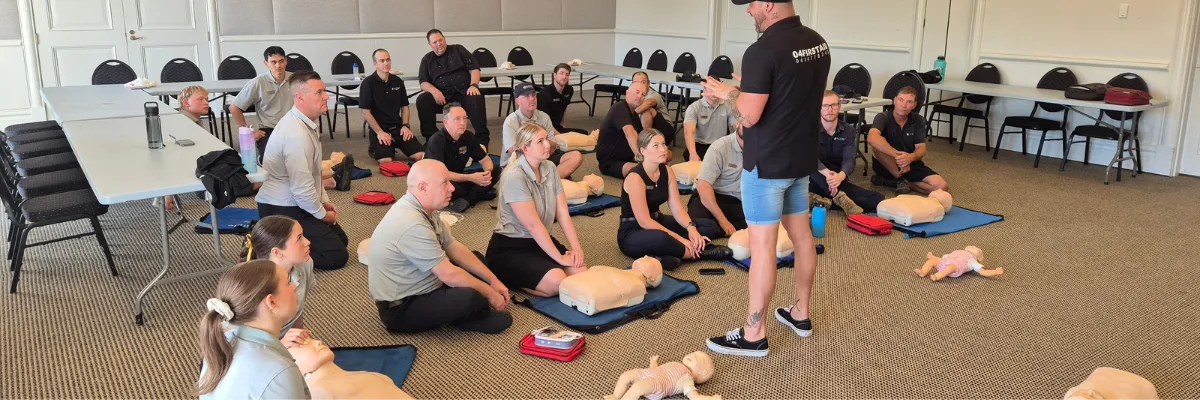
Sending a whole chairside team one by one to public classes means multiple dates, parking costs, lost hours and certificates trickling in. Onsite advanced resuscitation training in Brisbane fixes most of that in one go.
Here's what on-site HLTAID015 group training in Brisbane includes with Accelerate First Aid:
After-hours and Saturday sessions
Training on your own oxygen, suction and AED
Healthcare and dental chair scenarios
Certificates sent to the practice manager in one batch
Dental assistant practicing airway suction on a manikin during after-hours on-site HLTAID015 training in Brisbane
What an On-Site Session Looks Like
This is a general walk-through, not a specific client. The trainer arrives after the last patient leaves and checks your kit first, so problems turn up now rather than in a real emergency. The team then practices on the equipment they'll actually use, finishing with a realistic scenario like a patient deteriorating in the chair during a sedation list. That scenario goes straight into your drill log, and certificates arrive in one batch.
Next Steps for Your Practice Before the Next Accreditation Visit
Think about your next accreditation visit. The surveyor asks about emergency readiness and you don't go hunting. Every chairside staff member is current, the drill log is printed and sitting in the folder, and the AED pads are in date because someone checked them recently.
And think back to that sedation day in chair three. The assistant closest to the oxygen kit isn't guessing anymore. She's practiced on that exact regulator and suction unit, with the people she works beside every day. That's what an advanced resuscitation certificate is really for.
Step one is to list every chairside role in your practice and match it against the role matrix above. Write the names down so nobody gets missed, casuals and locums included.
Step two is to check everyone's HLTAID011 dates. Anyone doing HLTAID015 needs a current first aid certificate before they start, so sort out any lapsed ones now.
Step three is to request an on-site quote. If you're comparing options for HLTAID015 in Brisbane, get an on-site team quote and we'll work around your sedation lists.
Not quite ready to book? Grab the free Medical Emergency Readiness Kit, with the emergency kit checklist, drill log template and staff training tracker. When you're ready to train, your team will be ready too.